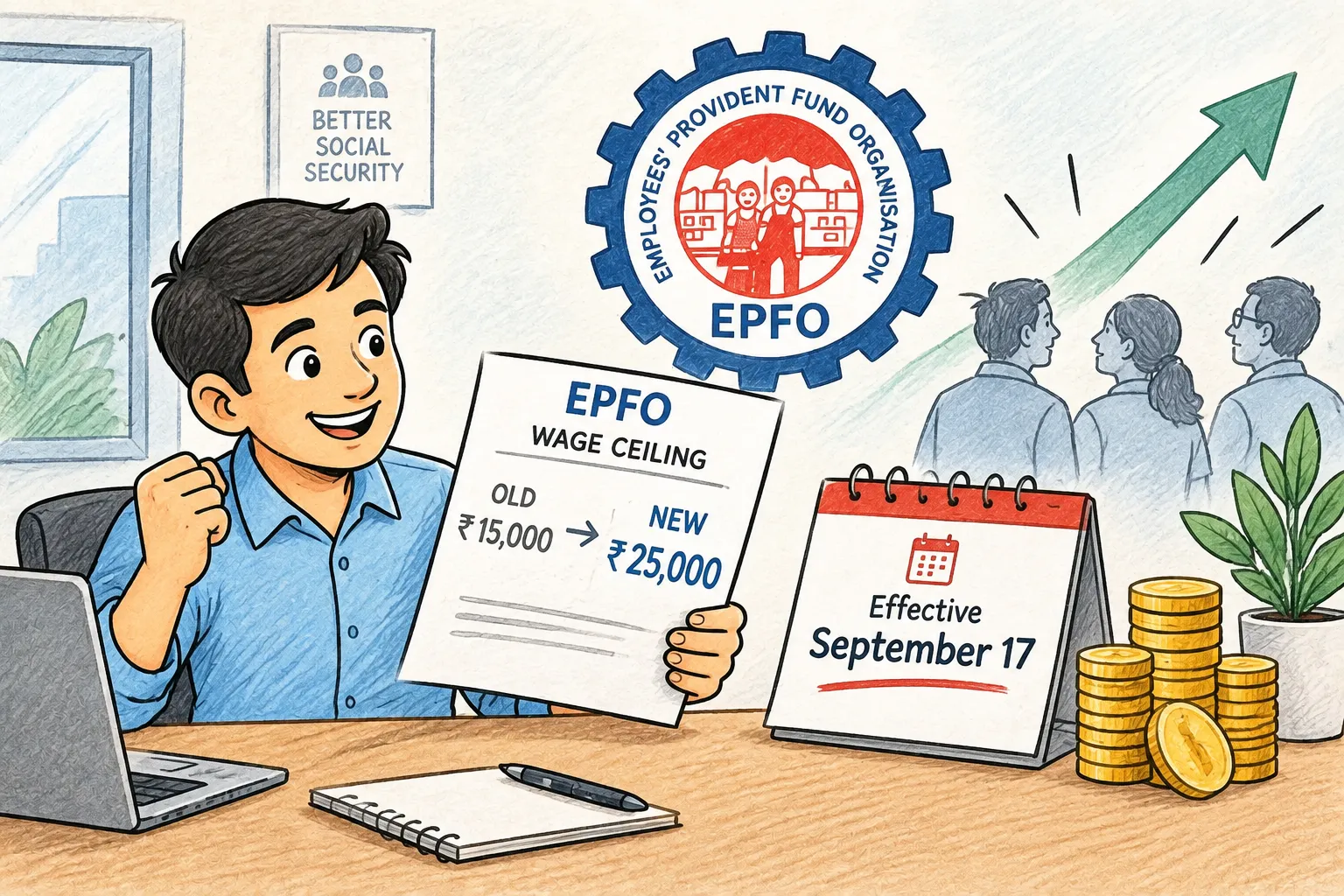
The Union Cabinet has raised the EPFO wage ceiling from Rs 15,000 to Rs 25,000 a month, effective September 17, 2026, a change expected to bring more than 51 lakh additional employees under mandatory provident fund coverage.
The Cabinet Decision
The Union Cabinet, chaired by Prime Minister Narendra Modi, approved a proposal from the Ministry of Labour and Employment to raise the wage ceiling for mandatory coverage under the Employees' Provident Fund Organisation from Rs 15,000 to Rs 25,000 per month. The change took effect from September 17, 2026, a date that coincided with Vishwakarma Jayanti, and was formally notified through a gazette notification issued under the Code on Social Security, 2020.
According to the Prime Minister's Office, the government expects the higher threshold to bring more than 51 lakh additional employees within mandatory EPFO coverage, widening social security protection for workers who previously fell outside the scheme's compulsory ambit. The wage ceiling had remained unchanged for more than a decade, having last been revised from Rs 6,500 to Rs 15,000 in September 2014.
Why the Ceiling Existed and Why It Moved
Under the EPF Act, any employee drawing a basic salary at or below the wage ceiling must be compulsorily enrolled in the EPF scheme, with both employee and employer contributing 12 percent of basic wages each month. Employees earning above the ceiling were previously classified as excluded employees, meaning enrolment for them was optional rather than mandatory. Because the ceiling had stayed frozen at Rs 15,000 since 2014 despite rising wages, a growing share of entry level and mid level employees had drifted above the threshold and out of compulsory coverage over the years.
Raising the ceiling to Rs 25,000, a jump of Rs 10,000 or roughly 66.7 percent, reconnects the mandatory coverage threshold with current wage levels and is intended to expand the pool of workers with guaranteed access to provident fund savings and retirement benefits.
What Changes for Employees and Employers
For employees whose wages fall between the old and new ceiling, the revised threshold changes how much is deducted from take home pay. Because the change took effect mid month, employers must compute September 2026 contributions on a split basis: the Rs 15,000 ceiling for September 1 to 16, and the Rs 25,000 ceiling from September 17 to 30.

| Change | Detail |
| Old wage ceiling | Rs 15,000 per month |
| New wage ceiling | Rs 25,000 per month |
| Effective date | September 17, 2026 |
| Additional employees covered | More than 51 lakh |
| Maximum added employee contribution | Up to Rs 1,200 a month |
| Last revision before this one | September 2014 |
Employees who are members of the Employees' Pension Scheme will also see their pensionable wage ceiling rise in step, with pension contributions now computed on wages up to Rs 25,000, translating to a maximum monthly EPS contribution of about Rs 2,083. New entrants can join EPS only if their basic pay at joining is at or below the revised Rs 25,000 ceiling, while employees already above that level remain covered under EPF alone.
The Cost to Employers, and a Government Offset
For employers, wider mandatory coverage means an increase in matching contributions for employees whose wages now fall within the new ceiling, since the employer's 12 percent share must rise in step with the employee's. To help offset this added cost, the government has pointed employers toward the Pradhan Mantri Viksit Bharat Rozgar Yojana, which offers an employer incentive of up to Rs 3,000 per eligible additional employee per month for enrolments valid until July 31, 2027.
Employers have been advised to identify employees whose wages exceed Rs 15,000 but had been remitted only up to that ceiling, bring them into coverage from September 17, complete know your customer formalities including Aadhaar, bank account and PAN details, and file e-nomination forms for newly covered staff.
Also Read: Titan Open to Buying Smaller Watch Brands, Cites Festive Demand
What This Means Going Forward
The revised ceiling is a structural change to India's social security architecture rather than a one time announcement, and its effects will show up gradually in payroll processing, take home pay calculations and retirement savings balances over coming months. Workers whose wages sit near the new Rs 25,000 threshold should expect a modest reduction in monthly take home pay in exchange for a larger, mandatory retirement contribution.