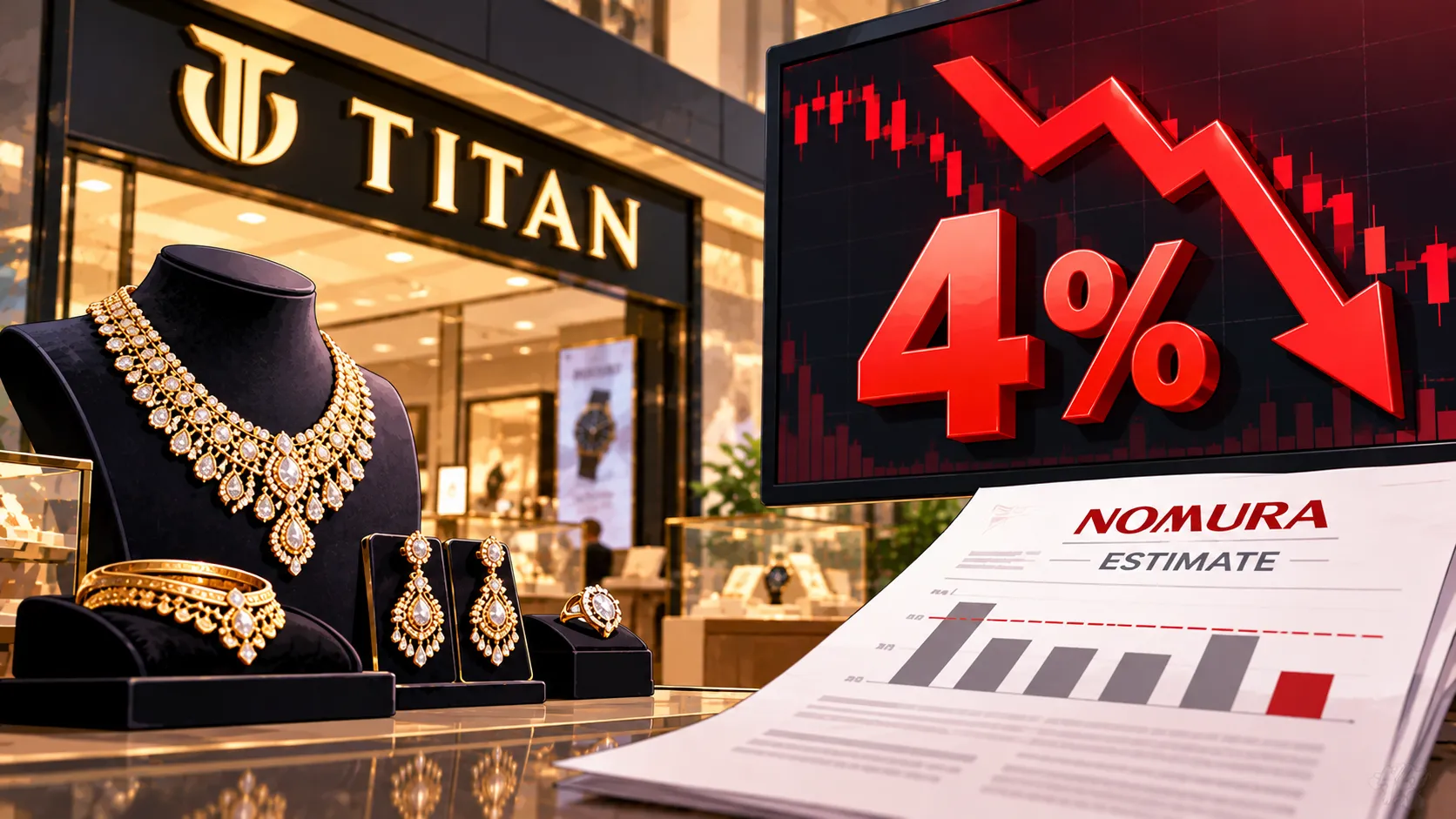
Titan Company shares fell about 4% on October 7, 2026, after its September-quarter business update showed 25% growth in consumer businesses but jewellery sales up 21%, below the roughly 25% that brokerage Nomura had expected.
What Titan Reported for the September Quarter
Titan Company said its consumer businesses grew about 25% year-on-year in the second quarter of FY27, covering July to September 2026. The figure excludes bullion, digital gold and TEAL. The numbers are provisional and subject to limited review by the company's statutory auditors, so they are a business update and not audited results.
The 25% growth compares with 41% reported for the June quarter and with 20% in the second quarter of FY26, according to the company's update as summarised by HDFC Sky and Sahi. Growth was led by jewellery, watches and eyecare, each of which grew more than 20%.
| Business | Q2 FY27 Growth, Year-on-Year |
| Consumer businesses (overall) | About 25% |
| Jewellery (all brands) | About 21% |
| Watches | 30% |
| EyeCare | 28% |
| Tanishq, Mia, Zoya and beYon | About 20% |
| CaratLane | 32% |
| Taneira | High single digit |
| International business | 97% |
Why the Stock Fell Despite Double-Digit Growth
Titan shares dipped about 4% to ₹4,370 on the BSE, and Business Standard reported an intraday low of ₹4,371. The reason was the gap between what Titan delivered and what the market expected, not weak growth in absolute terms.
Nomura's estimate for jewellery growth was around 25%, and Titan's jewellery business grew 21%. The core jewellery brands Tanishq, Mia and Zoya rose about 20%, also below Nomura's 25% estimate. The overall consumer business growth of 25% was broadly in line with the brokerage's expectation, which means the shortfall appeared in jewellery.
Nomura cited high jewellery sales bases and elevated gold prices as factors in the quarter, while noting that it still sees strong growth visibility.
Buyers, Ticket Sizes and What Customers Bought
Titan said buyer growth at the portfolio level was in the mid-single digits, while average ticket sizes grew in double digits. That combination suggests the revenue rise came more from customers spending more per purchase than from a large increase in the number of buyers.
Within jewellery, studded jewellery grew in the early thirties in percentage terms and plain gold jewellery grew about 20%, while demand for gold coins fell by a high single-digit percentage, according to Sahi's summary of the update. The update does not give margin data, so the effect of this product mix on profitability cannot be assessed yet.

Because the update excludes bullion, digital gold and TEAL, the 25% and 21% figures describe Titan's core consumer sales and not its total turnover. Readers comparing the numbers with other jewellery retailers should check whether those companies include or exclude similar categories, since definitions differ and can change the headline growth rate.
Stores and the International Push
Titan added 78 net stores across its consumer businesses in the quarter, compared with 55 in the second quarter of FY26. The jewellery division added 42 stores, taking its network to 1,269.
The international business grew 97%, a figure that includes Damas Jewellery, in which Titan holds a 67% stake and which has been consolidated since January 2026. Because of that consolidation, part of the jump reflects the acquisition and not only organic growth. Titan said its jewellery brands Tanishq, Mia and CaratLane continued to post strong double-digit growth in North America. In the Gulf Cooperation Council region, the company said its business had held up well in a volatile geopolitical environment, with Tanishq recording improving growth and Damas showing early signs of recovery.
What the Update Does Not Show
A quarterly business update covers sales trends, not profitability. Titan has not yet released its detailed Q2 FY27 financial results, which will show operating margins and profit. Gold prices, which Nomura described as elevated, are one factor the full results may help explain.
For readers tracking the company, three points stand out from the update. Consumer growth of 25% matched expectations. Jewellery growth of 21% fell short of one brokerage's estimate of around 25%. And the market's reaction on October 7 shows how closely Titan's shares respond to the jewellery growth figure when the full results are still pending.
The Sensex closed 429.11 points lower at 72,638.70 on October 7 after the Reserve Bank of India raised the repo rate by 25 basis points, so Titan's decline came on a weak day for the broader market.