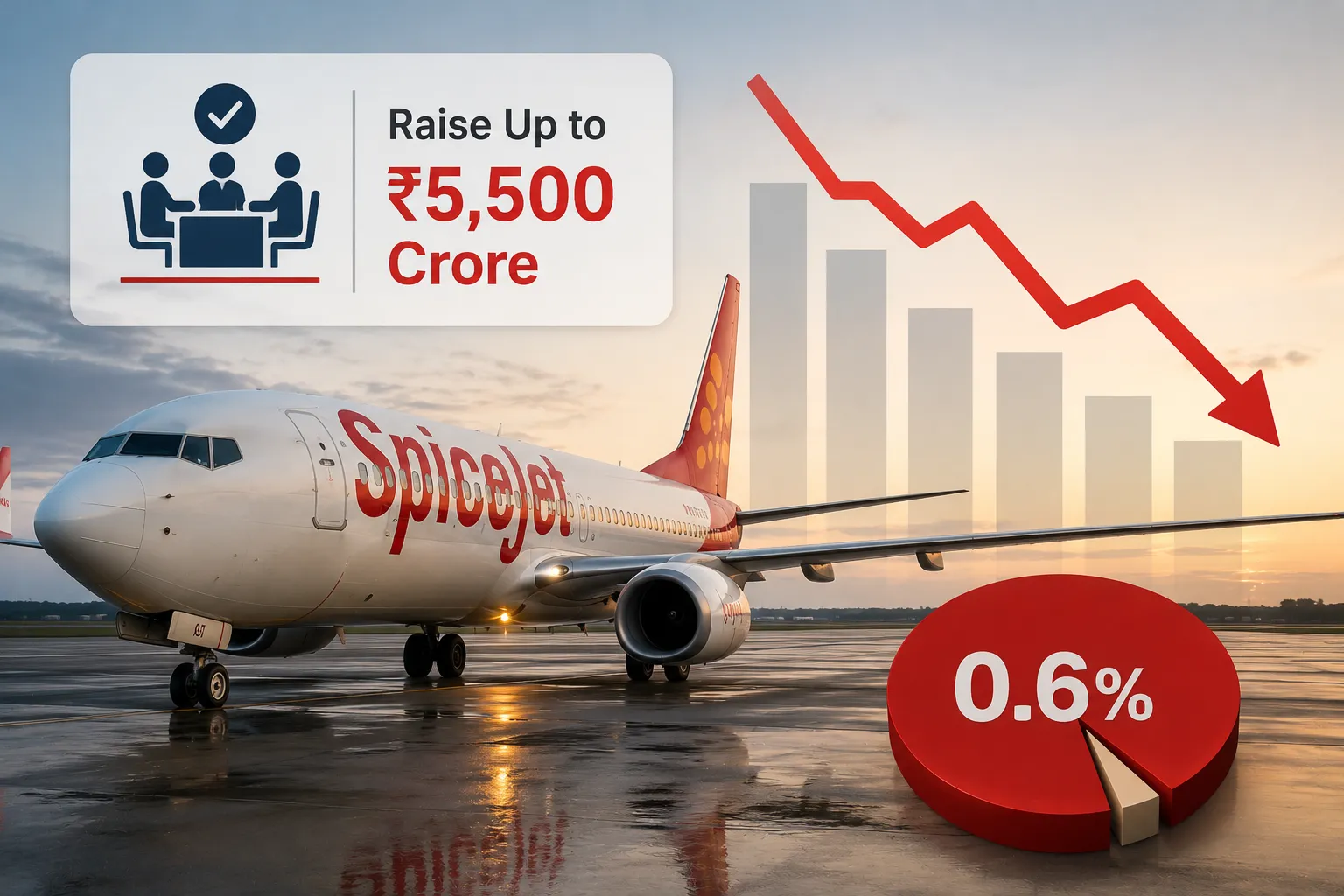
SpiceJet’s board approved raising up to ₹5,500 crore and a rise in authorised capital to ₹7,500 crore on Wednesday. The airline faces unpaid dues and shrinking operations, and its shares hit the 5% upper circuit.
What the Board Approved
SpiceJet’s board approved a proposal on Wednesday, November 18, 2026, to raise up to ₹5,500 crore through one or more fundraising routes. The airline is also in discussions with potential new investors, and the board has directed management to speed up the process, the company said in a press release.
The proposed fundraise could involve a combination of equity and other permitted financial instruments. Equity means raising money by issuing shares to investors. The board also approved a 3.75-fold increase in authorised share capital, from ₹2,000 crore to ₹7,500 crore, subject to shareholder and regulatory approvals.
| Item | Detail |
| Proposed fundraise | Up to ₹5,500 crore |
| Route | Equity and other permitted instruments |
| Authorised share capital | Increase from ₹2,000 crore to ₹7,500 crore |
| Approvals needed | Shareholder and regulatory approvals |
| Investor talks | Under way with potential new investors |
Authorised share capital is the maximum value of shares a company is permitted to issue. Raising the limit gives SpiceJet room to issue more shares in the future. It does not by itself raise any money.
Share Price Reaction
SpiceJet shares rose 4.95% to ₹9.97 on Wednesday, hitting the 5% upper circuit. The stock had already gained about 30% over the previous six sessions on expectations that the board would consider a fundraise. Even so, the share price has fallen nearly 73% over the past 12 months.
The Cash Crunch Behind the Plan
The board’s decision comes as the airline grapples with unpaid dues, salary delays and operational disruptions linked to payment disputes with service providers and aircraft lessors. Several recent events show how the shortage of cash has reached day-to-day operations:
- Dubai check-in suspension: On November 12, Dubai Airports suspended check-in services for SpiceJet over outstanding dues of about ₹35.85 crore to ground-handling company Dnata. Four flights were cancelled.
- Salary delays: Employees have faced delays in pay, with some dues reportedly outstanding for more than four months.
- Supplier dues: SpiceJet’s filing for April to September 2026 showed that ₹63.03 crore of the ₹122.93 crore it owed to micro, small and medium enterprises remained unpaid beyond the mandatory 45-day deadline. The airline had not cleared more than 85% of invoices from small suppliers within that period.
Management and Company Explanation
SpiceJet’s chairman and managing director, Ajay Singh, said in a statement that the fundraise would give the airline an opportunity to rebuild its operations and restore the brand. He acknowledged the challenges ahead and said the company has a plan and is focused on putting the necessary building blocks in place, with discipline in execution.
The airline attributed the pressure on its operations to geopolitical disturbances and airspace restrictions. It also said that aviation turbine fuel prices have more than doubled over the past few months, which has raised operating costs significantly. The company said the fundraise would give it the financial headroom to address its operational challenges and strengthen its balance sheet.

A Shrinking Airline
The airline’s domestic market share has dropped sharply. According to data from the Directorate General of Civil Aviation (DGCA), SpiceJet’s domestic share fell to 0.6% in September from 3.9% in January. It slipped below regional carrier Star Air’s 0.7% for the first time.
| Measure | January 2026 | September 2026 |
| Domestic market share | 3.9% | 0.6% |
| Domestic passengers carried | 5.92 million | 730,000 |
The financial and operational difficulties have also drawn the government’s attention. In September, Civil Aviation Minister K Rammohan Naidu said the DGCA was carrying out operational and financial scrutiny of the airline to ensure passenger convenience and safety.
The Financial Record
SpiceJet reported consolidated net losses in each of the six financial years from FY19 to FY24, with accumulated losses of about ₹5,950 crore. It then posted a modest profit of ₹62 crore in FY25. In the first three quarters of FY26, however, it incurred cumulative losses of about ₹1,117 crore.
The airline has not yet released its results for the fourth quarter of FY26 or for the first and second quarters of FY27. Missing results make it hard for outside investors to see the current state of the company’s finances, which is one of the open questions around the fundraise.
What to Watch Next
The next steps are the shareholder and regulatory approvals for the higher authorised capital, the identity of any new investors, and the terms of the fundraise, including the price, the amount of equity to be issued and the dilution for existing shareholders. None of these has been disclosed.
The airline’s share price has risen sharply in a few sessions, but the company is raising money from a weak position, with a falling market share, unpaid dues and delayed results. The fundraise is an approval to seek money, not money in hand, and the outcome will depend on whether investors commit funds on terms the company can accept.