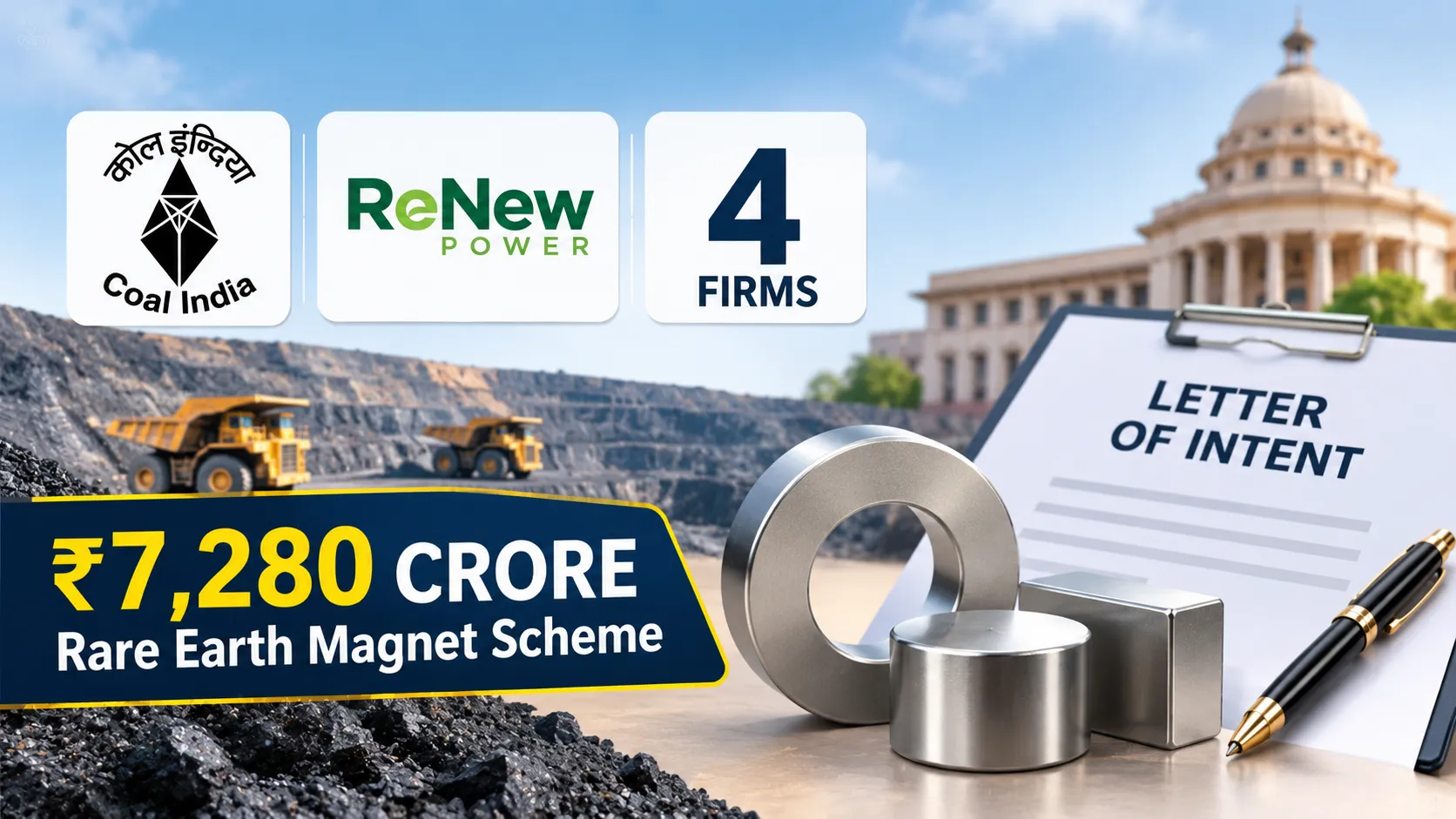
The government issued letters of intent on November 19 to four firms under its ₹7,280 crore rare earth magnet scheme. Coal India’s consortium with NFTDC was declared the L2 bidder for a 1,200 tonne a year plant.
What Was Announced
The Ministry of Heavy Industries issued letters of intent on Thursday, November 19, 2026, to four companies under the Scheme to Promote Manufacturing of Sintered Rare Earth Permanent Magnets. The four are Coal India, ReNew, Prozeal Green Energy and Midwest Energy. Heavy Industries Minister H D Kumaraswamy said the initiative would strengthen domestic manufacturing, reduce import dependence and advance self-reliance.
Coal India disclosed the award in a filing to the stock exchanges. The company said a consortium led by it, with the Non-Ferrous Materials Technology Development Centre (NFTDC) as the other member, has been declared the L2 bidder. The letter of intent is dated November 19, 2026.
| Detail | Coal India consortium |
| Lead member | Coal India |
| Consortium partner | Non-Ferrous Materials Technology Development Centre (NFTDC) |
| Bidder status | L2 |
| Planned capacity | 1,200 tonnes per annum of sintered rare earth permanent magnets |
| Product | Sintered neodymium-iron-boron (NdFeB) magnets |
| Project period | Seven years: two years of pre-construction and five years of operation |
| Order type | Domestic |
What L2 Means
In Indian government tendering, L1 refers to the lowest bidder and L2 to the second lowest. Under this scheme, bidding runs through a two-stage least cost system on the central procurement portal, and the total capacity is meant to be shared among five beneficiaries. The Coal India filing states the plant capacity of 1,200 tonnes per annum and the seven-year timeline, but the reports reviewed do not explain how the L2 ranking affects the consortium’s final allocation.
The consortium will set up the facility through a special purpose vehicle formed under the scheme. A letter of intent is an early-stage award and not a contract, so the details of how it converts into a final order are still to come. The reports reviewed also do not give the capacities awarded to ReNew, Prozeal Green Energy and Midwest Energy.
The Scheme Behind the Awards
The Union Cabinet approved the scheme on November 26, 2025, with a total outlay of ₹7,280 crore. The outlay has two parts: ₹6,450 crore of sales-linked incentives on magnet sales over five years, and ₹750 crore of capital subsidy for setting up manufacturing facilities.
| Feature | Detail |
| Total outlay | ₹7,280 crore |
| Sales-linked incentives | ₹6,450 crore over five years |
| Capital subsidy | ₹750 crore |
| Planned capacity | 6,000 metric tonnes per annum |
| Number of beneficiaries | Five |
| Raw material support | Limited assured supply from IREL (India) Ltd |
The scheme covers integrated manufacturing, from converting rare earth oxides into metals, then into alloys, and finally into finished magnets. The Ministry of Heavy Industries invited bids in March 2026 and opened the technical bids on August 13, 2026. It received 20 bids at that stage, from companies including Larsen and Toubro, Coal India, ReNew, Attero Recycling and several joint ventures and consortiums.
Why India Wants Its Own Magnet Industry
Rare earth permanent magnets are among the strongest types of permanent magnets. They are used in electric vehicles, wind turbines, electronics, and aerospace and defence systems, because they allow compact and powerful motors.

India depends heavily on imports for these products. China accounts for more than 80% of India’s permanent magnet imports by quantity, and Chinese export controls on rare earth products in April 2025 disrupted supplies to Indian industries. The scheme is meant to build processing, refining and magnet-making capabilities that remain underdeveloped in the country.
What It Means for Coal India
The award takes Coal India into a business outside its core coal mining activity. The company has been working to diversify, and the magnet plant adds a manufacturing project in the critical minerals area. The filing classified the order as domestic.
Coal India shares closed at ₹391.50 on Thursday, up 0.90%. The filing does not give an investment figure for the plant, and the reports reviewed do not state what the capital outlay will be. For that reason, the financial effect on the company is not yet clear.
What to Watch Next
Several points remain open. The conversion of the letters of intent into formal awards, the final capacity allocated to each beneficiary, the investment each company will make, and the timetable for the two-year pre-construction phase are the key details still to be disclosed.
Industries that use these magnets will also be watching how quickly domestic capacity builds. The scheme aims for 6,000 tonnes a year across five beneficiaries, and the four letters issued so far cover part of that plan. The awards are an early step, but they move the scheme from bidding to selection of companies, in an effort to reduce reliance on one dominant supplier.