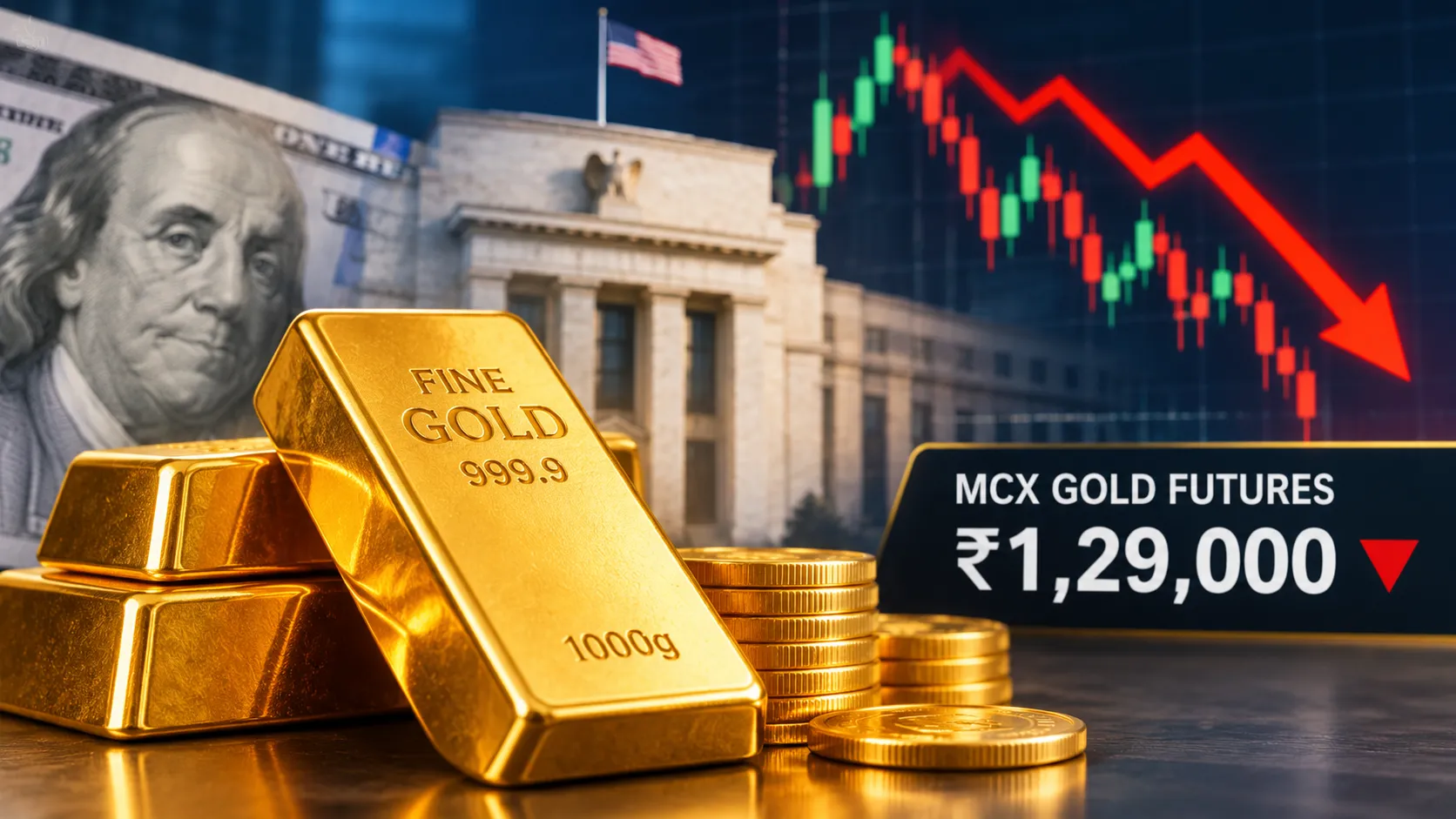
Gold fell to a 14-month low on Thursday as a stronger dollar and expectations of a Fed rate hike weighed on the metal. MCX December futures traded near ₹1,29,331 per 10 grams, below the ₹1.30 lakh mark.
Where Gold Stands
Gold eased to its lowest level in 14 months on Thursday, November 19, 2026. Spot gold was down 0.3% at $3,710.29 per ounce in US morning trade, after touching $3,693.13 earlier in the session, its lowest since September 2025. US gold futures for December delivery fell 0.8% to $3,711.50 per ounce.
| Market | Latest level | Move |
| Spot gold | $3,710.29 per ounce | Down 0.3% |
| US gold futures (December) | $3,711.50 per ounce | Down 0.8% |
| MCX gold (December) | ₹1,29,331 per 10 grams | Down ₹483 (0.37%) |
| MCX silver (December) | ₹1,61,500 per kg | Up ₹768 (0.48%) |
| Spot silver | $45.28 per ounce | Up 0.6% |
The decline extends a slide that has been under way for several sessions. On November 12, spot gold fell below $4,000 an ounce after hotter-than-expected US inflation data pushed up expectations of a rate hike.
What Is Driving the Decline
Two forces are working together: a stronger US dollar and expectations of higher US interest rates. Markets are now fully pricing in a rate increase at the Federal Reserve’s December meeting because of stubborn inflation. Traders see a 91% chance of a 25 basis point increase and a nearly 9% chance of a larger 50 basis point increase.
Minutes from the Fed’s October meeting, released on Wednesday, showed that almost all policymakers expected interest rates to need to move higher. They also showed that officials saw rising inflation risks that might warrant a stronger policy response. Several Fed officials, including Governor Christopher Waller and Governor Michael Barr, made comments during the week that supported tighter policy.
The dollar index reached its highest level since April 2, 2025 this week. A stronger dollar makes gold, which is priced in dollars, more expensive for buyers who hold other currencies. Higher interest rates also reduce the appeal of gold, which pays no interest, because holding it means giving up income from other assets.
The Indian Picture
On the Multi Commodity Exchange, December gold futures were trading at ₹1,29,331 per 10 grams, down ₹483 or 0.37% from the previous close of ₹1,29,814. By 12:30 pm, the metal had touched an intraday high of ₹1,29,796 and a low of ₹1,28,310.
Silver moved the other way. December silver futures traded at ₹1,61,500 per kg, up ₹768 or 0.48% from the previous close of ₹1,60,734, with an intraday high of ₹1,62,175 and a low of ₹1,59,321. Internationally, silver rose 0.6% to $45.28 per ounce, platinum gained 0.7% to $1,380.30 and palladium fell 1.4% to $934.86.

What Analysts Say Could Change the Direction
An analyst quoted by Reuters said that the near-term outlook depends on demand. Prices would need stronger buying from both consumers and central banks to recover from the one-year low. The analyst added that recent computer outages and worries about artificial intelligence could lead some investors to turn back to hard assets such as gold.
That view points to a balance between two sets of forces. Rate expectations and the dollar are pushing prices down, while safe-haven demand and physical buying could provide support if investors become more cautious.
Why It Matters in India
Gold is a major part of household savings in India, and price swings affect jewellery buyers, jewellery retailers and lenders that offer loans against gold. A lower price makes jewellery cheaper for buyers, though the final retail bill also includes making charges and GST.
Jewellery retailers such as Senco Gold reported record festive sales for the period ending November 11, and the value of such sales depends on both the quantity bought and the price paid. On Wednesday, shares of several jewellery companies fell sharply in a weak market, although the market reports did not link the whole move to gold prices.
What to Watch Next
The Federal Reserve’s December meeting is the next major event for gold, because the market has already priced in a quarter-point increase. A larger hike or a more hawkish message would add to pressure on prices, while a softer tone could help them recover.
For Indian buyers and investors, the dollar’s strength and the rupee’s movement also matter. The MCX price reflects both the global price and the exchange rate, so a firmer rupee can lower the domestic price even when the global price is steady.