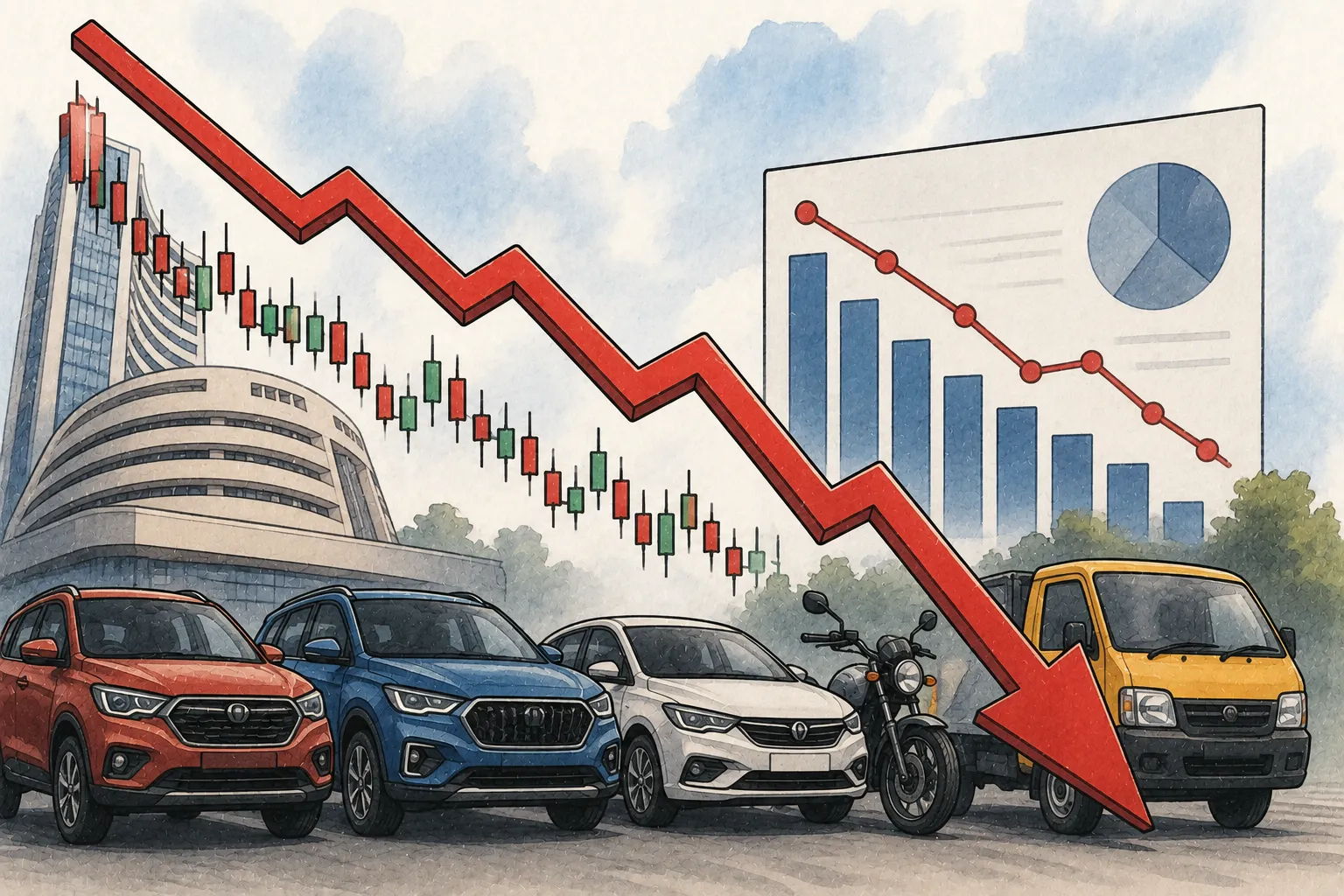
The Nifty Auto index came under broad selling pressure on Wednesday, 2 September, even as August sales updates from major automakers pointed to solid year-on-year growth across passenger vehicles, commercial vehicles and two-wheelers.
In early trade, the Nifty Auto index dropped as much as 2.38% to 27,802.65. At 10:15 AM, the index was down 2.09% at 27,896, compared with a 0.87% fall in the Nifty 50. All 15 Nifty Auto constituents were reported lower at that stage of trading.
The weakness was notable because the monthly sales data released a day earlier had included strong growth figures from Tata Motors Passenger Vehicles, Maruti Suzuki, Bajaj Auto and TVS Motor. The market response suggested that investors were looking beyond one month’s dispatch data and focusing on the outlook for demand, costs and margins.
Hero MotoCorp leads broad auto-sector weakness
Hero MotoCorp was among the steepest intraday decliners, falling as much as 6.8% to ₹5,173. Bajaj Auto, Mahindra & Mahindra and TVS Motor also declined more than 3% at their respective intraday lows, signalling that the pressure was not confined to one segment of the automobile market.
Eicher Motors, a key listed two-wheeler manufacturer through Royal Enfield, also faced selling despite reporting higher August volumes. Passenger-vehicle names, commercial-vehicle makers and auto-component companies were similarly affected.
The sell-off extended to auto ancillary stocks, including Bosch, Sona BLW Precision Forgings, Samvardhana Motherson International, Bharat Forge, Uno Minda, Exide Industries and Tube Investments of India. That wider participation indicated a sector-level reassessment rather than a reaction to a single company-specific announcement.
A later intraday market reading showed the Nifty Auto index down 3.25%. Since this was an intraday move, it should not be read as the index’s final closing change for the day.
August sales showed uneven strength across companies
Automakers had released August 2026 sales updates on 1 September, and several companies reported strong increases from a year earlier. Tata Motors Passenger Vehicles reported total sales of 67,753 units for the month, a 56% year-on-year increase. Its domestic passenger-vehicle sales rose about 59% to 65,253 units.
Tata Motors’ commercial-vehicle operations reported total domestic and international sales of 44,411 units, up 49% from the previous year. Maruti Suzuki reported total sales of 219,220 vehicles, representing a 21.32% year-on-year rise.
Bajaj Auto recorded total sales of 535,764 units, up 28% year-on-year. Its exports grew 51% to 280,056 units, making overseas volumes an important contributor to its monthly performance.
| Automaker | August 2026 reported sales | Year-on-year change |
| Tata Motors Passenger Vehicles | 67,753 units | Up 56% |
| Tata Motors commercial vehicles | 44,411 units | Up 49% |
| Maruti Suzuki | 219,220 units | Up 21.32% |
| Bajaj Auto | 535,764 units | Up 28% |
| TVS Motor | 616,540 units | Up 21% |
| Eicher Motors/Royal Enfield | 126,479 units | Up 11% |
| Hero MotoCorp | About 568,000 units | Up 2.6% |
TVS Motor reported total sales of 616,540 units, up 21% year-on-year. Eicher Motors, which owns Royal Enfield, reported total sales of 126,479 units, up 11%.
Hero MotoCorp’s performance was more modest relative to some peers. Total sales rose 2.6% to around 568,000 units, with domestic volumes up 4.5%. However, exports declined 24.5%, underscoring why a positive headline sales figure may not automatically translate into a positive stock-market reaction.

Investors looked past headline volume growth
Monthly auto-sales releases generally reflect wholesales or dispatches from manufacturers to dealers. They are important operational indicators, but they do not necessarily represent retail registrations or final consumer purchases during the same period.
For investors, that distinction matters. A rise in company dispatches can indicate improving demand and dealer confidence, but it also needs to be evaluated against inventory trends, retail offtake, discounting and the outlook for the next few months.
Market commentary around the August data also pointed to the possibility that some year-on-year gains were aided by a softer comparison base in August 2025. This does not negate the reported sales increases, but it can affect how investors assess the durability of growth.
The results were also mixed when measured against market expectations. Reported commentary indicated that TVS Motor’s volume performance was below one brokerage’s expectation, while Hero MotoCorp’s growth lagged some faster-growing peers. In a market that has already priced in favourable demand conditions, even strong year-on-year numbers can trigger selling if they do not exceed expectations.
Crude prices and sentiment add to margin concerns
The decline in auto shares coincided with concerns around higher crude oil prices and broader geopolitical uncertainty. A rise in crude can affect the auto sector through multiple channels: freight and logistics expenses may increase, input costs can face pressure, and higher fuel prices can influence vehicle-running costs for consumers.
The impact is not identical for every automaker. Companies with differing product mixes, export exposure, pricing power, sourcing arrangements and dealer networks may face different effects. Commercial-vehicle makers and manufacturers with higher transport dependence can be particularly sensitive to changes in freight economics, while passenger-vehicle and two-wheeler demand can be influenced by consumer affordability and fuel costs.
It would be inaccurate, however, to assign the full scale of the Nifty Auto decline to crude oil alone. The session reflected a combination of sector-specific concerns and a weaker broader market mood.
Also Read: Annu Projects Lists at Up to 27% Discount to IPO Price
What the market will track after August sales
The immediate takeaway is that strong August dispatches did not settle investor concerns about the next phase of the demand cycle. The market is likely to monitor festive-season retail demand, dealer inventory, pricing actions, discounts, exports and management commentary on margins.
For Bajaj Auto, export momentum will remain an important factor after the company reported a 51% rise in August exports. For Hero MotoCorp, investors may watch whether domestic growth improves and whether export volumes stabilise. Tata Motors, Maruti Suzuki, Mahindra & Mahindra and TVS Motor will also be assessed on whether their volume momentum is sustained beyond the August base-effect comparison.