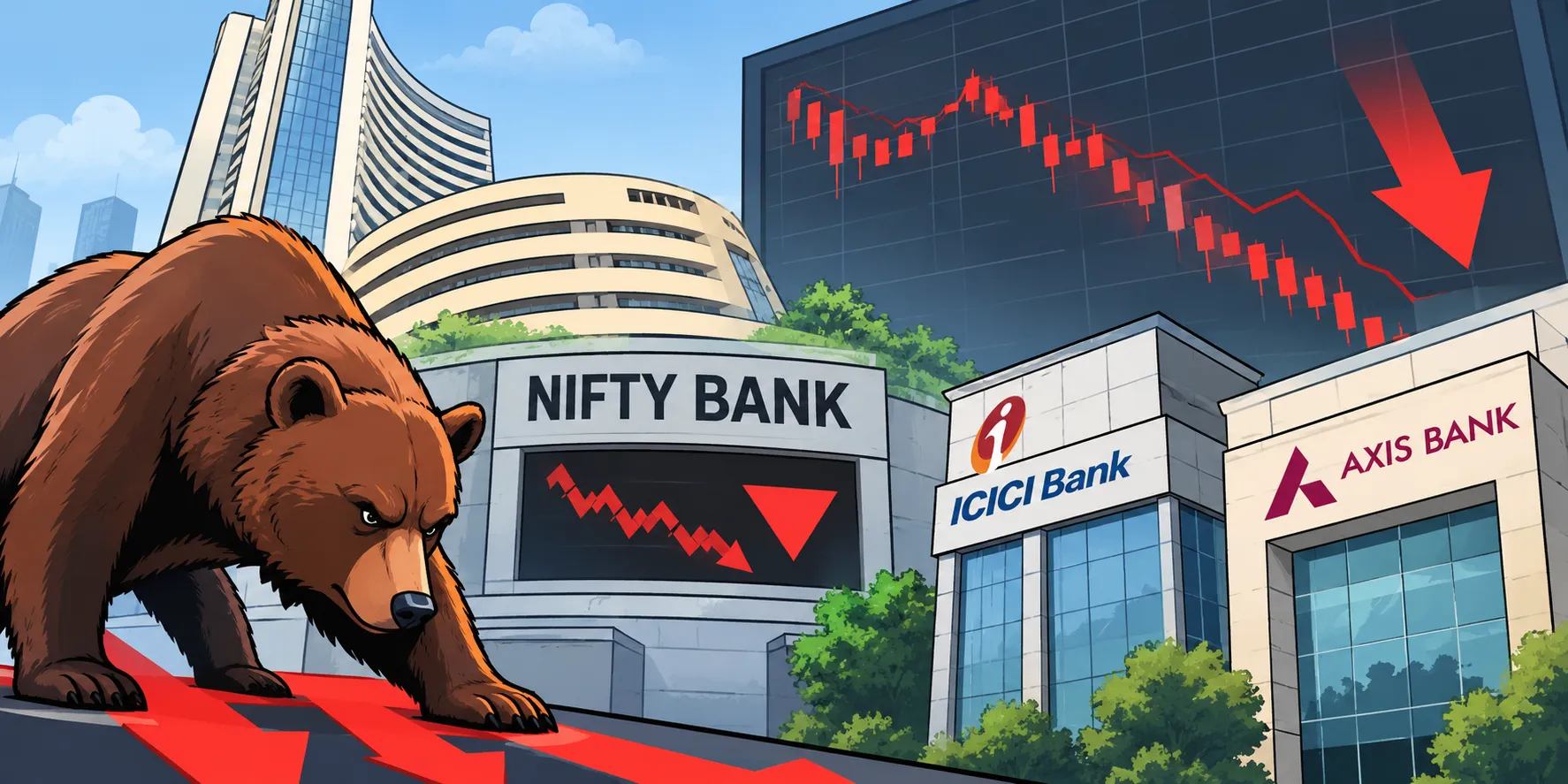
Bank Nifty extended its decline on Tuesday, September 8, falling below 57,000 for a third straight session as major banking shares weakened alongside a wider sell-off in Indian equities.
At around 12 pm IST, the Nifty Bank index stood at 56,865.85, down 0.4% for the day. Axis Bank was lower by 1.8%, ICICI Bank declined 1.7%, Union Bank of India fell 1.2%, and HDFC Bank traded 0.9% lower.
The pressure on lenders came amid higher crude oil prices and continuing US-Iran tensions, which contributed to a risk-off mood across domestic markets. The available information indicates a broader market-driven move rather than a verified company-specific development at the affected banks.
Bank Nifty weakness persists beyond noon
The banking index remained under pressure into the afternoon. By around 12:34 pm IST, Bank Nifty was reported at 56,773.10, down 0.55% for the session.
ICICI Bank traded at ₹1,398.40, down 2.04%, in the later intraday snapshot. Axis Bank was quoted at ₹1,242.95, down 1.92%, in a BSE Bankex snapshot.
| Banking indicator or stock | Verified intraday movement on September 8 |
| Bank Nifty | 56,865.85, down 0.4% around 12 pm IST |
| Bank Nifty | 56,773.10, down 0.55% around 12:34 pm IST |
| ICICI Bank | Down 1.7% around 12 pm IST |
| ICICI Bank | ₹1,398.40, down 2.04% in a later intraday snapshot |
| Axis Bank | Down 1.8% around 12 pm IST |
| Axis Bank | ₹1,242.95, down 1.92% in a BSE Bankex snapshot |
| HDFC Bank | Down 0.9% around 12 pm IST |
| Union Bank of India | Down 1.2% around 12 pm IST |
All figures are intraday observations, not official closing prices. Bank Nifty and individual share prices can change materially before the market closes, especially during sessions shaped by macroeconomic or geopolitical risk.
The index’s move below 57,000 was notable because it followed declines in the prior two sessions. However, the reviewed information does not establish a new earnings development, RBI action, SEBI measure, asset-quality update or exchange filing as the direct cause of the day’s banking-stock weakness.
Bank shares move with a weaker broader market
The selling in major lenders was accompanied by declines in India’s benchmark indices, reinforcing the market-wide character of the session.
In early trade, the BSE Sensex fell 382.25 points to 75,750.56, while the Nifty 50 declined 97.80 points to 23,681.80. At around 10:04 am IST, the Sensex stood at 75,705.92, down 426.89 points or 0.56%, and the Nifty was at 23,659.25, lower by 119.90 points or 0.50%.
Financial services, auto, realty, oil and gas, and banking stocks were among the weaker pockets in early trading. The simultaneous decline across several sectors suggests that broader risk sentiment was influencing price action rather than a problem limited to private or public-sector lenders.
ICICI Bank, Axis Bank, HDFC Bank and Union Bank of India are closely watched banking stocks and meaningful contributors to the sector’s direction. Their decline added to the downward move in Bank Nifty, but the available data does not identify a separate material development at any of the banks.
Brent crude near $98 fuels macro concerns
Brent crude was reported at $97.52 a barrel in early trade, up 0.54%. Higher oil prices are closely tracked by Indian markets because India is a major crude importer.

A sustained rise in crude can increase concerns around imported inflation, the current account and pressure on the rupee. These factors may, in turn, affect market expectations for interest rates, bond yields and equity valuations.
The link with bank stocks is largely through the broader macroeconomic outlook. Changes in expectations around inflation and borrowing costs can affect how markets value financial-sector companies, although a higher crude price does not by itself explain the movement of every banking share during a single session.
US-Iran hostilities added to uncertainty around oil supplies and investor risk appetite. The geopolitical backdrop was therefore a relevant market factor, but it should not be viewed as the sole reason for Bank Nifty’s intraday decline.
The prior session had also been weak
The September 8 fall extended pressure visible in the preceding session. On September 7, the Sensex had declined 382.62 points, or 0.50%, to close at 76,132.81.
The Nifty 50 had lost 118.55 points, or 0.50%, to close at 23,779.15 on September 7. The next day’s lower opening and continued weakness in banks therefore reflected an ongoing cautious phase for domestic equities rather than an isolated one-day reversal.
This context is important for readers searching for why banking stocks are falling today. The available market data points to a combination of declining risk appetite, elevated energy prices and geopolitical uncertainty, not a confirmed new issue at a particular lender.
Also Read: MCX Gold, Silver Rise as Dollar Weakens Before US Inflation Data
What the intraday move does and does not show
The day’s market action shows that banking shares were under pressure as Bank Nifty moved below 57,000 and the Sensex and Nifty also fell. It does not, on the evidence available, establish a deterioration in the operational or financial condition of ICICI Bank, Axis Bank, HDFC Bank or Union Bank of India.
For investors tracking bank shares through a demat account, it is useful to separate an intraday price move from an official company disclosure. Similarly, people using a trading account to follow market movements should note the timestamp, index level and broader market setting before drawing conclusions from a live quote.
Further clarity on the session will depend on final closing levels, the direction of crude oil prices and any subsequent official disclosures from the banks.