
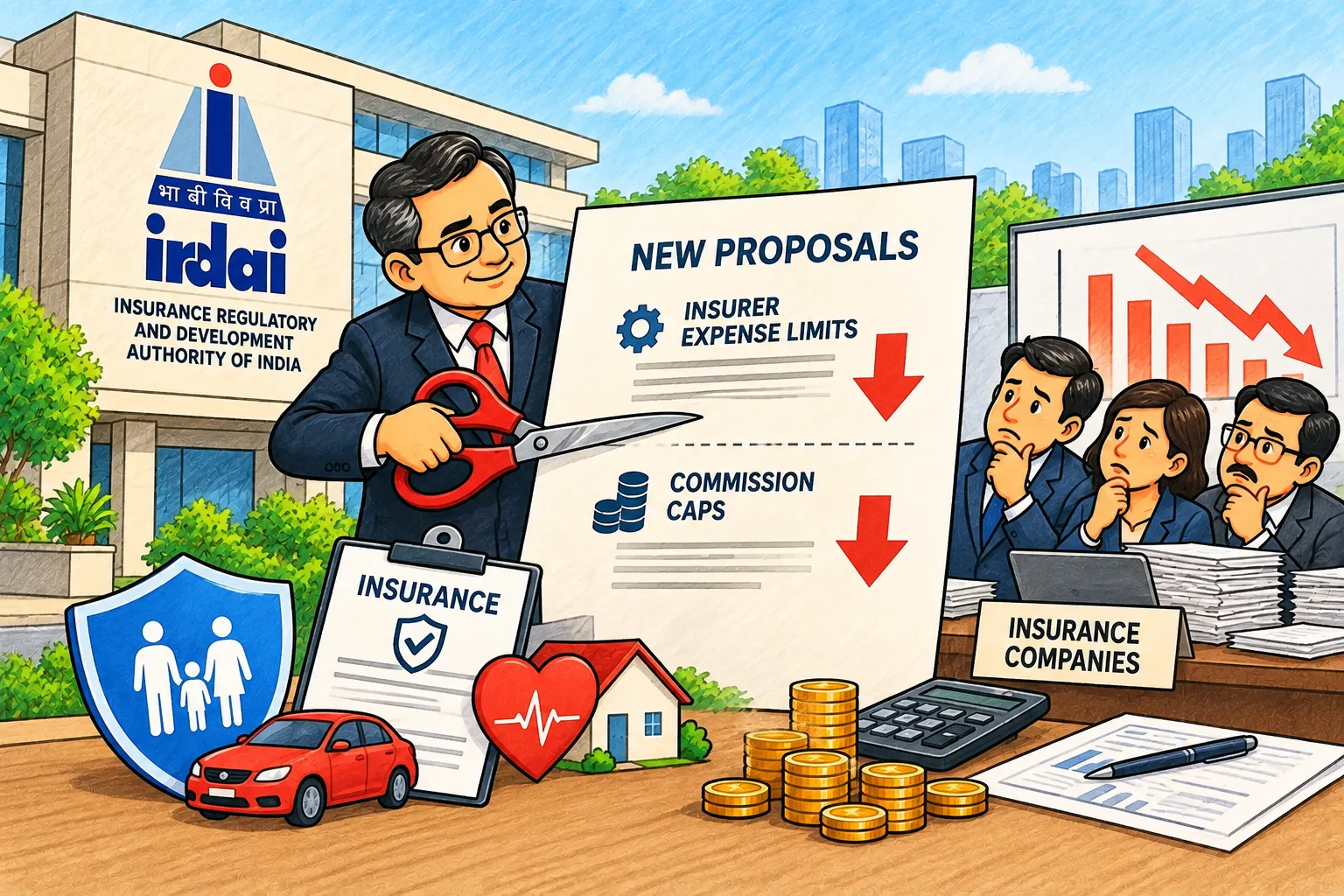
India's insurance regulator has proposed cutting life insurers' expense-of-management limit to 12.5% of premium income within five years, alongside new segment-wise commission caps and a ban on compulsory bundling of insurance with loans, aimed at lowering costs and curbing mis-selling.
The Expense Limit Cuts
The Insurance Regulatory and Development Authority of India (Irdai) on Wednesday proposed a phased reduction in the expenses of management (EoM) that insurers are permitted to incur. Life insurers would be required to bring their company-level EoM down to 15 per cent of gross direct premium income (GDPI) within two years, and to 12.5 per cent within five years.
For general insurers, Irdai proposed changing the benchmark itself, shifting it from gross written premium to domestic GDPI, while lowering the overall limit from 30 per cent to 20 per cent over five years. Insurers already operating below the proposed benchmarks in FY25 face a stricter long-term goal: 10 per cent EoM for life insurers and 20 per cent for general insurers within five years.
Irdai said the reductions are meant to lower the overall cost of insurance, widen the risk pool available in general insurance, and improve returns to policyholders in savings-linked life products.
New Commission Caps By Product
Alongside the EoM changes, Irdai proposed a new commission framework with limits varying by segment, distribution channel, product complexity, and the effort involved in selling and servicing a policy.
- Individual non-linked and linked products: commissions of 5 to 20 per cent for intermediaries, 6.25 to 25 per cent for agents
- Individual pure-term products: first-year commission of 25 per cent for intermediaries, 30 per cent for agents, with renewal commissions of 7.5 per cent and 10 per cent respectively
- Motor third-party cover: zero commission for distributors, 2.5 per cent for agents and associates
- Motor own-damage, personal accident and legal liability covers on new vehicles: 5 per cent for intermediaries, 10 per cent for agents
- Individual health insurance, first-time sales: around 15 per cent for distribution entities, 20 per cent for agents
Products sold in underserved areas may qualify for rewards above these normal limits, the regulator said. Irdai has also proposed cutting the regulatory fee insurers pay, from 0.05 per cent to 0.04 per cent of premium, capped at ₹20 crore.

Curbing Mis-Selling
The consultation paper also targets mis-selling directly. Irdai proposed banning the compulsory bundling of insurance with credit or loan products, while still permitting acceptable combinations of the two. It also proposed barring volume-linked or reward-linked incentives for bank and NBFC staff who sell insurance, and strengthening accountability where mis-selling occurs.
Cost audits would become mandatory for all insurer expenses, including payouts to intermediaries and non-monetary incentives, with distribution entities generating more than ₹100 crore in insurance-related revenue also required to undergo such audits. Irdai further proposed linking an individual's identity to each policy sold, publishing information on mis-selling incidents, and enabling clawback of commissions where mis-selling is established.
The paper also floats digital, pull-based Market Infrastructure Institutions for insurance distribution, naming Bima Sugam as one such platform.
Also Read: RBI Drains At Least $10 Billion Via Currency Swaps As Rupee Liquidity Surplus Swells
What It Means For Policyholders
If adopted, the proposals would reshape how insurers and their distributors are paid, and how much of every premium rupee goes toward acquisition costs rather than the policyholder's coverage or investment returns. Lower EoM ceilings, paired with tighter, product-specific commission caps, are designed to leave more of the premium working for the policyholder over time, particularly in savings-linked life products where high upfront costs have historically eaten into returns. The mis-selling curbs, especially the bundling ban and mandatory cost audits, target a persistent complaint among retail buyers: insurance sold as a condition of a loan rather than a genuine, informed purchase.