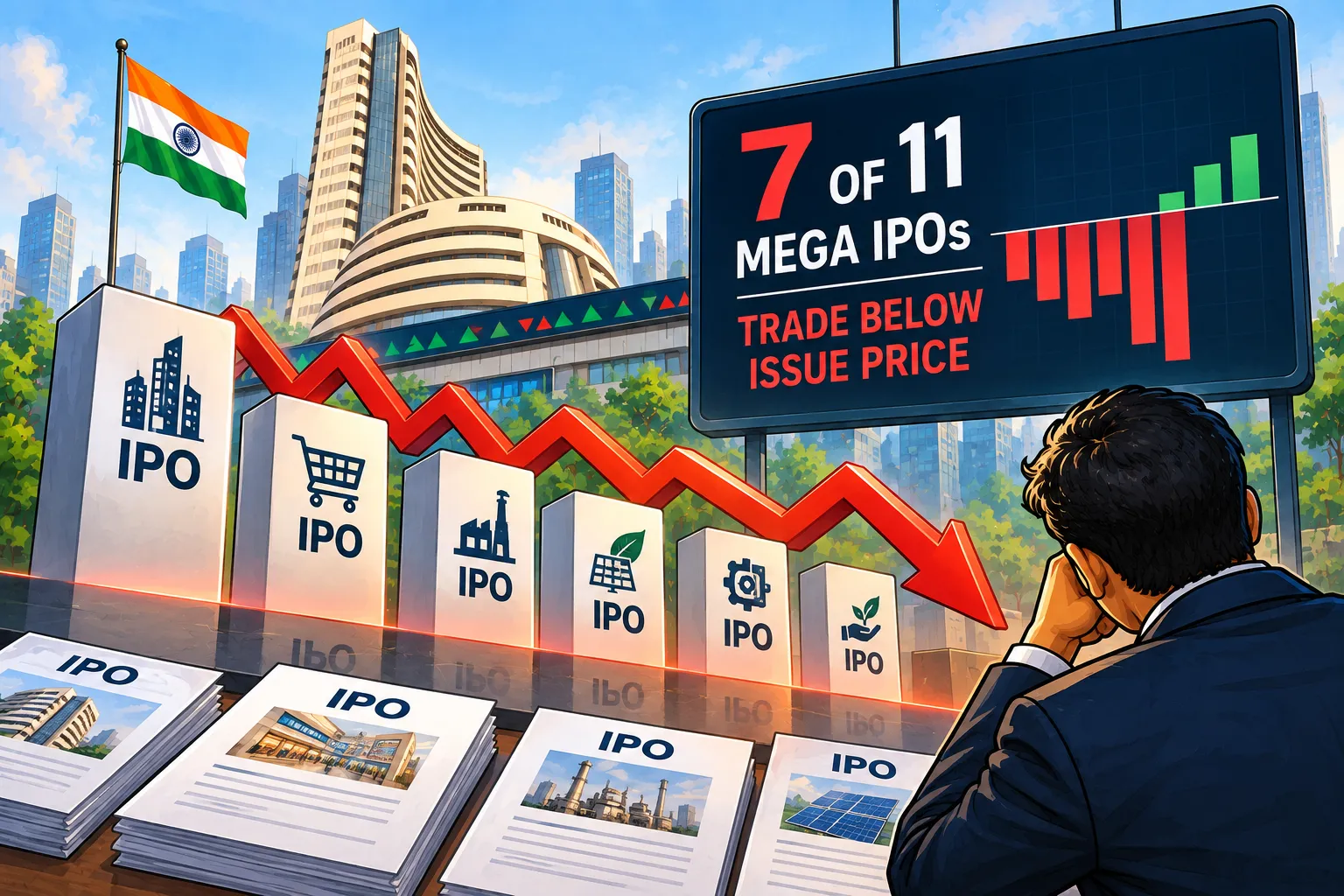
Seven of the eleven Indian IPOs that each raised over ₹9,500 crore since 2021, including the most recent NSE listing, are trading below their issue prices, with those seven names collectively down 15.3% from the ₹1.05 trillion they originally raised.
The Scorecard
Of the eleven mega IPOs that each raised more than ₹9,500 crore through public issues since 2021, seven are currently trading below their respective issue prices, including NSE, which raised ₹22,563 crore earlier this month. These seven companies collectively raised ₹1.05 trillion at IPO, a sum now valued 15.3 per cent lower at ₹88,979 crore.
The worst performers among the group are quick-commerce platform Swiggy, down 35 per cent against its issue price, and Paytm parent One 97 Communications, down 22 per cent. NTPC Green Energy, HDB Financial Services, Life Insurance Corporation of India (LIC), and the recently listed SBI Fund Management are all down in the 10-17 per cent range.
NSE's Own Struggles
NSE itself has already slipped below its issue price just days after its September 24 debut on the BSE. The stock closed at ₹1,769.30 on Tuesday, below its ₹1,785 issue price, and has fallen 6 per cent from its listing-day high of ₹1,878, hitting a low of ₹1,761 on September 28. NSE's IPO was India's second-largest ever, behind only Hyundai Motor India's ₹27,859 crore raise in October 2024, according to PRIME Database.
The Four That Held Up
Of the remaining four mega IPOs, Tata Capital is trading 1.5 per cent above its ₹326 issue price, and Hyundai Motor India is up 7 per cent. LG Electronics India and ICICI Prudential Asset Management Company have performed far better, rallying 53 per cent and 50 per cent respectively from their issue prices.
Why The Split
G Chokkalingam, founder and head of research at Equinomics Research, said the key determinant for mega-issue investors is pricing itself. "Pricing and the timing of the IPO are key to success. Investors draw comfort when the issue is priced attractively and the company is on a strong fundamental footing. Secondary market buoyancy also matters," he said, adding that if secondary markets stay tepid, both the pace of fresh issuance and listing-day pops are likely to fade.

Ratiraj Tibrewal, director at Choice Capital Advisors, echoed the pricing argument directly: LIC, Paytm and GIC, he said, were "priced to perfection," leaving little room for post-listing gains, whereas LG Electronics and ICICI Prudential Life "left something on the table for investors," which he believes explains their stronger post-listing performance.
Disclaimer: Views and outlook shared by G Chokkalingam and Ratiraj Tibrewal belong to those individuals and are not endorsed by this publication; investors should conduct their own due diligence.
Also Read: Apple Pay Launches In India, Axis Bank Credit Cards First To Get Tap-To-Pay
Why It Matters
The pattern across these eleven mega-IPOs is a useful corrective to the assumption that issue size alone signals investor safety: scale and pricing are different variables, and the data shows conservatively priced large issues (LG Electronics, ICICI Prudential AMC) outperforming aggressively priced ones (Paytm, LIC, and now trending that way, NSE) regardless of how "blockbuster" the headline fundraising number looked at the time. With India's mainboard IPO pipeline standing at ₹3.86 trillion, several multiples of what's actually been raised this year, how the next wave of large issues gets priced, not merely how much they aim to raise, will likely determine whether this list of underwater mega-IPOs grows longer.