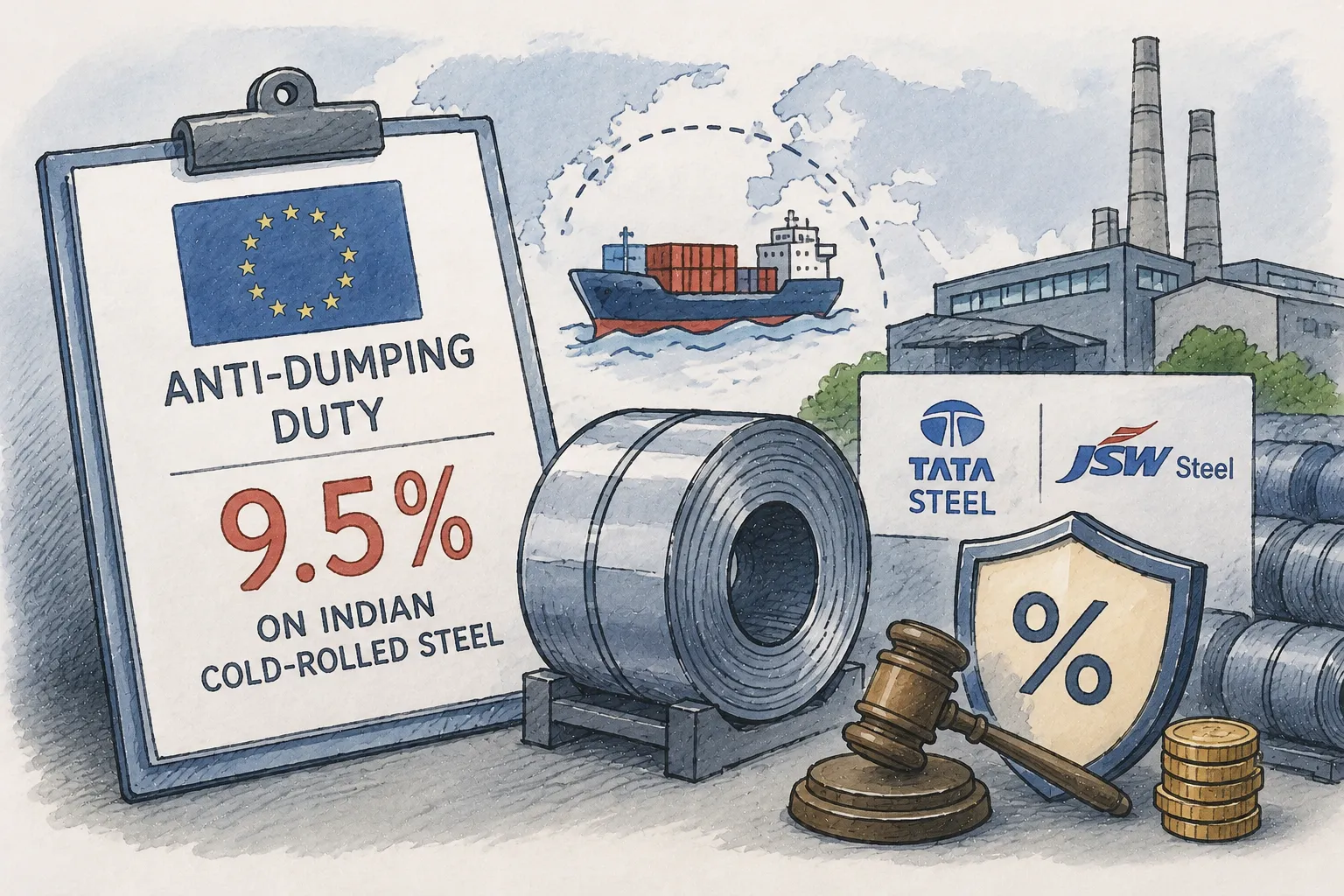
The European Commission imposed definitive anti-dumping duties of 9.5% on certain cold-rolled flat steel products from India on Monday. Tata Steel India, JSW Steel and JSW Steel Coated Products are named, and the duties take effect immediately.
What the Commission Decided
The European Commission announced on Monday, November 16, 2026, that it had imposed definitive anti-dumping duties on certain cold-rolled flat steel products imported into the European Union from India, Japan, Taiwan, Türkiye and Vietnam. The Commission said its investigation found that the products were entering the EU market at dumped prices, meaning below their normal value. Cold-rolled flat steel is commonly used across most areas of manufacturing.
India’s rate is a single 9.5% duty. Among the five countries, only Türkiye faces a lower range of duties.
| Country | Definitive anti-dumping duty |
| India | 9.5% |
| Japan | 27.9% |
| Taiwan | 20.7% to 27% |
| Türkiye | 3% to 7.8% |
| Vietnam | 16% |
Which Indian Companies Are Covered
The 9.5% rate applies to JSW Steel Limited, JSW Steel Coated Products Limited and Tata Steel India. The same rate applies to all other exporters from India. Tata Steel and JSW Steel were among the stocks in focus for Tuesday’s trading session after the announcement.
The Commission’s statement does not quantify how much revenue or profit any Indian company draws from these EU shipments. For that reason, the effect on the earnings of Tata Steel and JSW Steel is not yet measurable from the announcement alone, and investors will need to look to company disclosures.
How the 9.5% Rate Was Set
The EU applies a lesser duty rule, under which the final duty is capped at the lower of two measures: the dumping margin and the injury margin. In the Commission’s earlier disclosure to interested parties, the dumping margin for the Indian producers was 9.5%, while the injury margin was 25.5%. The lower of the two became the duty, which is why India’s final rate sits at 9.5%.
The Commission also said government measures in India had affected the domestic price of iron ore, a key raw material for cold-rolled flat steel. This finding formed part of the Commission’s reasoning on India. For Taiwan, the Commission pointed to excess steel production capacity in China and rising imports of Chinese cold-rolled steel, which put pressure on Taiwanese producers’ domestic prices.
How the Investigation Unfolded
The investigation was launched on September 18, 2025, after a complaint from the European Steel Association, known as EUROFER, on behalf of EU cold-rolled flat steel producers. It examined the period from July 1, 2024, to June 30, 2025. The Commission concluded that the EU industry had suffered material injury directly linked to the dumped imports, citing a deterioration in profitability, cash flow and return on investment.

The proposed 9.5% rate for Indian producers had already been disclosed to interested parties in August, so the figure itself was not a surprise. What changed on Monday is that the proposal became a binding duty with a date of effect.
The Trade Value at Stake
The numbers shared by the Commission show how large the cold-rolled flat steel market is and how much of it comes from the five countries under investigation.
- EU cold-rolled flat steel market: About €23.2 billion
- Imports from the five countries: About €1.77 billion
- Imports from India: About €282 million
- EU producers: Located in 12 member states, employing more than 8,600 people
India’s €282 million of shipments is a small share of the overall EU market, but it is a meaningful portion of the imports affected by the case. A duty of 9.5% on those shipments raises the landed cost for European buyers of Indian cold-rolled steel. How much of that increase Indian exporters absorb and how much is passed on will depend on contracts and market conditions.
Also Read: Sensex Rises 512 Points to 82,104 as Record Foreign Buying Lifts Large Caps While Small Caps Slip
What Investors and Industry Can Track
The immediate questions are practical ones. Exporters will assess whether to adjust pricing, shift volumes to other markets or continue shipping to the EU at the new landed cost. Because India’s duty is lower than the rates for Japan, Taiwan and Vietnam, Indian steel makers face a smaller penalty than those suppliers, although the range for Türkiye is lower than India’s.
Company commentary in the coming quarterly results calls is the most likely place for disclosures on the effect. Until then, the Commission’s decision is a trade-policy development with a defined rate, a defined list of named companies and a date of effect, and not a quantified financial event for any single Indian steel maker.