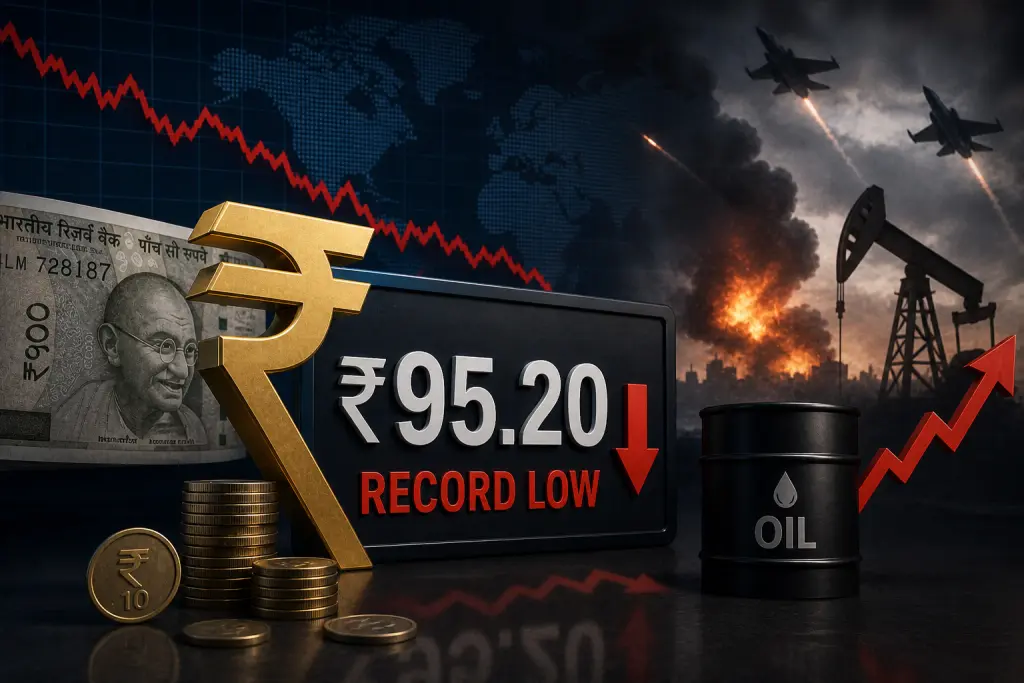
The Indian Rupee has depreciated to a record low of 95.20 against the US Dollar, driven by surging global oil prices exceeding $100 per barrel and escalating war tensions in the Middle East. This development intensifies concerns for Indian investors, as higher import costs threaten to stoke inflation and pressure equity portfolios. Oil marketing companies and import-dependent sectors face immediate headwinds, while market sentiment turns cautious amid foreign institutional investor outflows and geopolitical uncertainties.
Indian Rupee Hits Record Low at 95.20: Oil Surge and War Tensions Weigh Heavy
The Rupee's plunge to 95.20 marks a critical threshold for India's external sector. Global crude prices have surged past $100 per barrel, with recent peaks near $126, amplifying import bills. War tensions in the Middle East add volatility, rattling forex markets and equity benchmarks.
What Happened: Timeline of Rupee's Sharp Fall
The Rupee's decline accelerated on Thursday, hitting 95.20 amid a potent mix of elevated oil prices and dollar strength fueled by war risks. Crude oil breached $100 per barrel earlier in the week, driven by Middle East supply disruptions. Central banks globally, including the ECB and BoE, held rates steady, citing oil-driven inflation risks. The BoE warned of CPI exceeding 6% if oil sustains at $130 per barrel. This context pressured emerging market currencies like the INR. FII selling has persisted, with $122 million outflows in recent sessions, compounded by slowing industrial production. The combination has eroded investor confidence, pushing the Rupee to uncharted lows.
Market Data Snapshot
Indian benchmarks reflected the strain, with
and
posting declines amid broader risk-off sentiment.
Metals and
led sectoral losses, down 2-4%, as higher input costs bit. Financials showed mixed performance, with some resilience despite Rupee pressure.
Investor Impact: Sectors Hit and Opportunities
Currency depreciation elevates import costs, particularly for oil, which constitutes over 80% of India's energy imports. This fuels wholesale price index (WPI) and consumer price index (CPI) inflation, squeezing margins for oil marketing companies like
and
. Aviation firms face elevated fuel expenses, while broader manufacturing contends with cost pass-through challenges. Exporters, however, benefit from competitive pricing in dollar terms, aiding sectors like textiles and pharmaceuticals. India's forex reserves above $703 billion offer a buffer against sharp volatility.
and pharma, with lower import exposure and dollar revenues, exhibit relative stability. Historical Rupee lows, such as 83.50 in 2022, saw similar patterns: initial equity dips followed by exporter-led recoveries.
Expert Analysis: Macro Linkages and Outlook
Oil surges directly link to India's inflation metrics, with every $10 per barrel rise adding 0.3-0.4% to CPI. RBI may intervene via spot market sales or dollar swaps to temper volatility, as seen in prior episodes. Bond yields have climbed to multi-year highs, signaling market expectations of tighter policy. This reflects caution over persistent inflation from energy costs and war-related supply shocks. Financial services have bucked the trend, gaining modestly amid rotational flows. Cyclical sectors show signs of stabilization globally, but India remains sensitive to external shocks. Geopolitical risks could prolong oil elevation, testing RBI's balancing act between growth and price stability.
Actionable Guidance for Investors
Investors should track RBI announcements on forex interventions and monitor Brent crude trajectories for import cost signals. Diversification into rupee-hedged assets or exporter-oriented names can mitigate currency risks. Consider platforms to
online for efficient portfolio rebalancing. The best
stock trading and investing platform
in India can facilitate access to real-time data and execution. Nifty support near 23,000 warrants attention for potential entry levels, alongside BSE/NSE volume trends.
Outlook
Markets eye upcoming US non-farm payrolls and RBA decisions, which could influence dollar dynamics and oil sentiment. Persistent war tensions may sustain Rupee pressure, but robust reserves and exporter tailwinds provide counterbalances for selective opportunities.
Conclusion
The Rupee at 95.20 underscores the interplay of global oil shocks and geopolitics on India's economy. Investors must prioritize risk management, staying attuned to RBI actions and sectoral shifts for informed positioning in this volatile environment.