
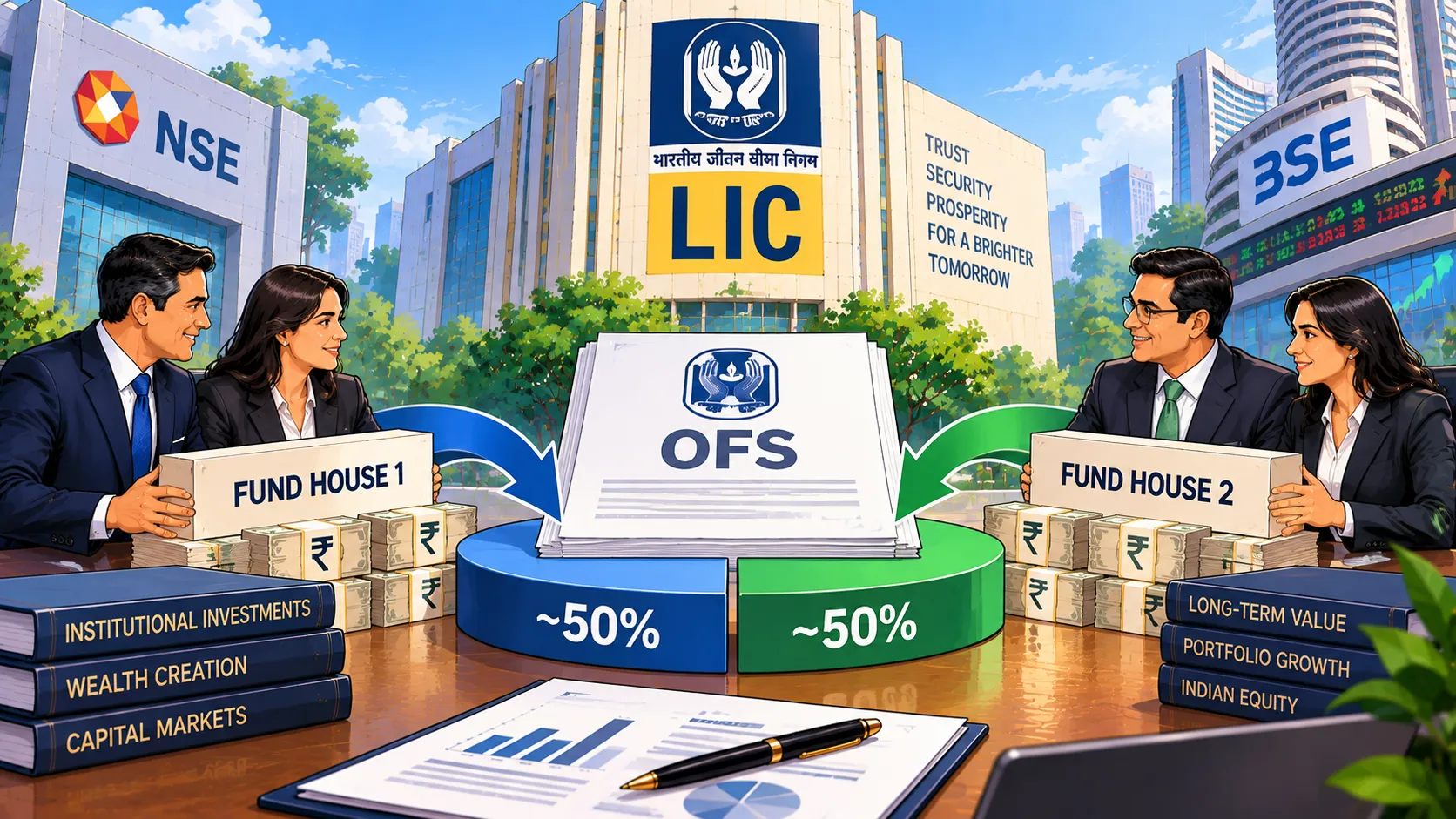
ICICI Prudential Mutual Fund and SBI Mutual Fund together picked up shares worth ₹17,145 crore in the government's August offer for sale in LIC, more than half of the ₹31,552 crore issue.
Where the LIC Shares Went
Two fund houses accounted for the bulk of the demand in India's largest secondary share sale. ICICI Prudential Mutual Fund and SBI Mutual Fund together acquired close to 423.9 million LIC shares worth ₹17,145 crore during August, according to an analysis of the latest mutual fund holding data sourced from Prime Database.
ICICI Prudential Mutual Fund was the single largest buyer. Its LIC holding went from 62 million shares at the end of July to 334 million shares at the end of August.
| Fund house | Net purchase in August | Holding, end July | Holding, end August |
| ICICI Prudential MF | ₹11,003 crore | 62 million shares | 334 million shares |
| SBI MF | ₹6,142 crore | 15 million shares | 167 million shares |
| HDFC MF | ₹1,775 crore | not reported | not reported |
| Quant MF | ₹758 crore | nil | 18.7 million shares |
Quant Mutual Fund is the notable new entrant on that list. It held no reported position in LIC at the end of July and bought 18.7 million shares during August.
Mutual Fund Ownership Jumped From Under 1 Per Cent to 5.4 Per Cent
The scale of the shift in LIC's shareholder register is the more significant number. Mutual funds as a category held less than 1 per cent of LIC as of July 2026. By the end of August that had risen to 5.4 per cent.
Across the industry, mutual funds increased their LIC holdings by roughly ₹24,123 crore during August. That is equivalent to 76.5 per cent of the total value of the offer for sale, which means domestic funds, rather than foreign or retail investors, absorbed most of the government's stake sale.
How the August Stake Sale Was Structured
The offer for sale was conducted over two trading days in early August and was the government's biggest disinvestment transaction of the financial year.
- Dates: August 4, 2026 for non-retail investors and August 5, 2026 for retail investors and eligible employees
- Floor price: ₹382 per share, with a ₹10 per share discount for retail investors and employees
- Size: 6.5 per cent of LIC's equity, or about 82.2 crore shares, made up of a base offer and a greenshoe option
- Amount raised: ₹31,552 crore, more than double the original base target
- Bankers: IIFL Capital Services, BNP Paribas Securities India, Goldman Sachs India and Motilal Oswal Investment Advisors
For comparison, LIC's May 2022 initial public offering raised about ₹21,000 crore by selling a 3.5 per cent stake at ₹949 per share. The August transaction raised more money from a lower price because it sold nearly twice the quantum of equity.
The Deadline That Drove the Sale
The sale was not opportunistic. LIC had to raise its public shareholding to 10 per cent to satisfy the minimum public shareholding norm, and the Securities and Exchange Board of India had set a deadline of May 16, 2027 for that, after granting a three-year extension in May 2024.

Before the offer for sale, the government held 96.5 per cent of LIC and public shareholders held 3.5 per cent. The 6.5 per cent sale takes public shareholding to 10 per cent, which clears that requirement ahead of schedule.
A larger obligation remains. LIC still has to reach 25 per cent public shareholding, for which the Department of Economic Affairs granted a one-time exemption in December 2023 allowing 10 years from the listing date, taking that deadline to May 2032. On the current arithmetic, roughly 15 percentage points of government stake will need to change hands before then.
Why These Figures Are Estimates, Not Allotments
One qualification matters for anyone reading the fund-house numbers as an allotment table. The figures are derived from month-on-month changes in mutual fund portfolios, not from the offer for sale allocation records.
A fund could therefore have bought LIC shares in the open market during August rather than through the offer for sale, and the two cannot be separated in monthly holding data. The numbers may differ from the actual offer for sale allocations.
Also Read: Tata Sons Listing Cleared, but Tata Trusts Refuse to Agree
What the Change Means for LIC's Register
A stock that was 96.5 per cent government-owned until August now has a genuine institutional float, most of it held by two large domestic fund houses. That changes the mechanics of trading in the stock in two ways.
Free float and index weights are calculated on public shareholding, so a jump from 3.5 per cent to 10 per cent alters how passive money treats the counter. At the same time, concentration matters. When a handful of fund houses hold the majority of a newly created float, the stock's liquidity depends heavily on what those few investors decide to do with the position.
The way the sale was run also shaped that outcome. Officials in the divestment department withheld the launch date to stop traders from taking positions that could have pushed LIC's price down before the government sold, and the four banks advising on the transaction were not all informed at the same time, according to a Bloomberg report. The sale went on to raise more than double its original target across two trading days.