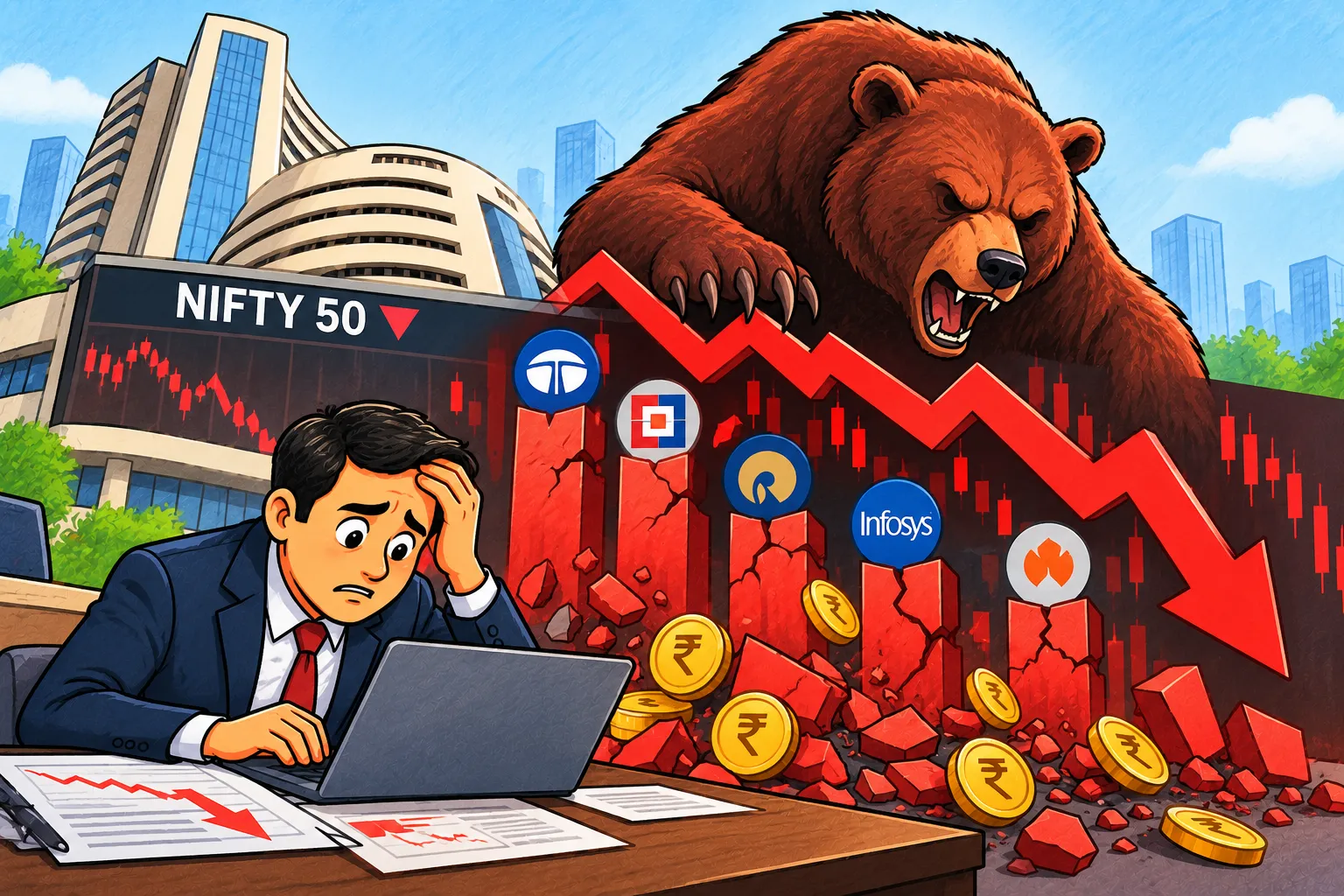
Eighteen of the Nifty 50's constituent stocks, including Infosys, Wipro, TCS and ITC, are now trading more than 20% below their 52-week highs, a combined ₹31.35 trillion in market value erased even as the Nifty itself is down a comparatively milder 10-12% from its peak.
The Scale Of The Damage
Data compiled by Business Standard Research shows that 18 of the 50 Nifty stocks are now trading more than 20 per cent below their respective 52-week highs, a threshold market convention treats as entering a "bear grip." Combined, the decline in these 18 stocks has erased ₹31.35 trillion in market capitalisation. The Nifty 50 index itself closed at 23,140.5, against its 52-week high of 26,373.2 recorded on January 5, 2026, a milder overall decline of 10-12 per cent that masks how much steeper the damage is in specific large-cap names.
Infosys has seen the steepest fall among large-caps, down 42.1 per cent from its high, followed by Wipro (39.9 per cent), Tata Consultancy Services (37.9 per cent), ITC (36.9 per cent), Tata Motors Passenger Vehicles (35.1 per cent, though this figure is complicated by Tata Motors' earlier business demerger) and HDFC Life Insurance (32.7 per cent).
Where The Losses Are Concentrated
| Stock | Decline from 52-week high |
| Infosys | 42.1% |
| Wipro | 39.9% |
| Tata Consultancy Services | 37.9% |
| ITC | 36.9% |
| Tata Motors PV | 35.1% |
| HDFC Life Insurance | 32.7% |
| Maruti Suzuki India | 30.5% |
| HCL Technologies | 29.3% |
| Jio Financial Services | 28.4% |
| HDFC Bank | 27.9% |
The mark-to-market impact is largest among the biggest index heavyweights in absolute terms. Reliance Industries' market capitalisation has fallen from ₹21.35 lakh crore at its 52-week high to ₹16.59 lakh crore currently, a decline of about ₹4.76 lakh crore. HDFC Bank's market cap has fallen from ₹15.49 lakh crore to ₹11.34 lakh crore, while State Bank of India's has dropped from ₹11.29 lakh crore to ₹9.07 lakh crore. Infosys alone has lost around ₹2.82 lakh crore in market value, and TCS has shed roughly ₹4.14 lakh crore.
What's Driving It
Santosh Meena, head of research at Swastika Investmart, described the correction as a genuine valuation reset rather than a fundamental breakdown, noting many of these stocks had run up sharply in prior years to elevated multiples. He attributed the broader pressure to profit-booking, higher global bond yields, elevated crude prices, and sector-specific headwinds concentrated in high-weight IT and banking names.

On IT specifically, Meena pointed to persistent concerns over AI-driven disruption to traditional application development and maintenance revenue streams. On banking and financial stocks, he cited regulatory overhang from proposed insurance commission and expense reforms (a reference to Irdai's recent draft rules), higher global yields and crude, FII outflows, and margin pressure from funding costs, compounded by banks' outsized weight in the index.
Also Read: Bank Strike Called Off As UFBU, IBA Agree To Panel On Five-Day Week
Prathamesh Kadival, research analyst at Bonanza, offered a more constructive read, arguing the underlying companies retain strong earnings, low debt and steady cash flows, meaning the fall looks driven more by sentiment than fundamentals. He said an upside reversal typically begins once valuations turn attractive and FII selling eases, with rising domestic inflows, improving quarterly results and stable interest rates as the signals to watch. Kadival added that IT specifically has stayed the weak spot because global clients have delayed tech spending while a firm rupee compounds the pressure, with money rotating out of IT into financials.
Disclaimer: Views and outlook shared by brokerage analysts belong to those firms and are not endorsed by this publication; investors should conduct their own due diligence.