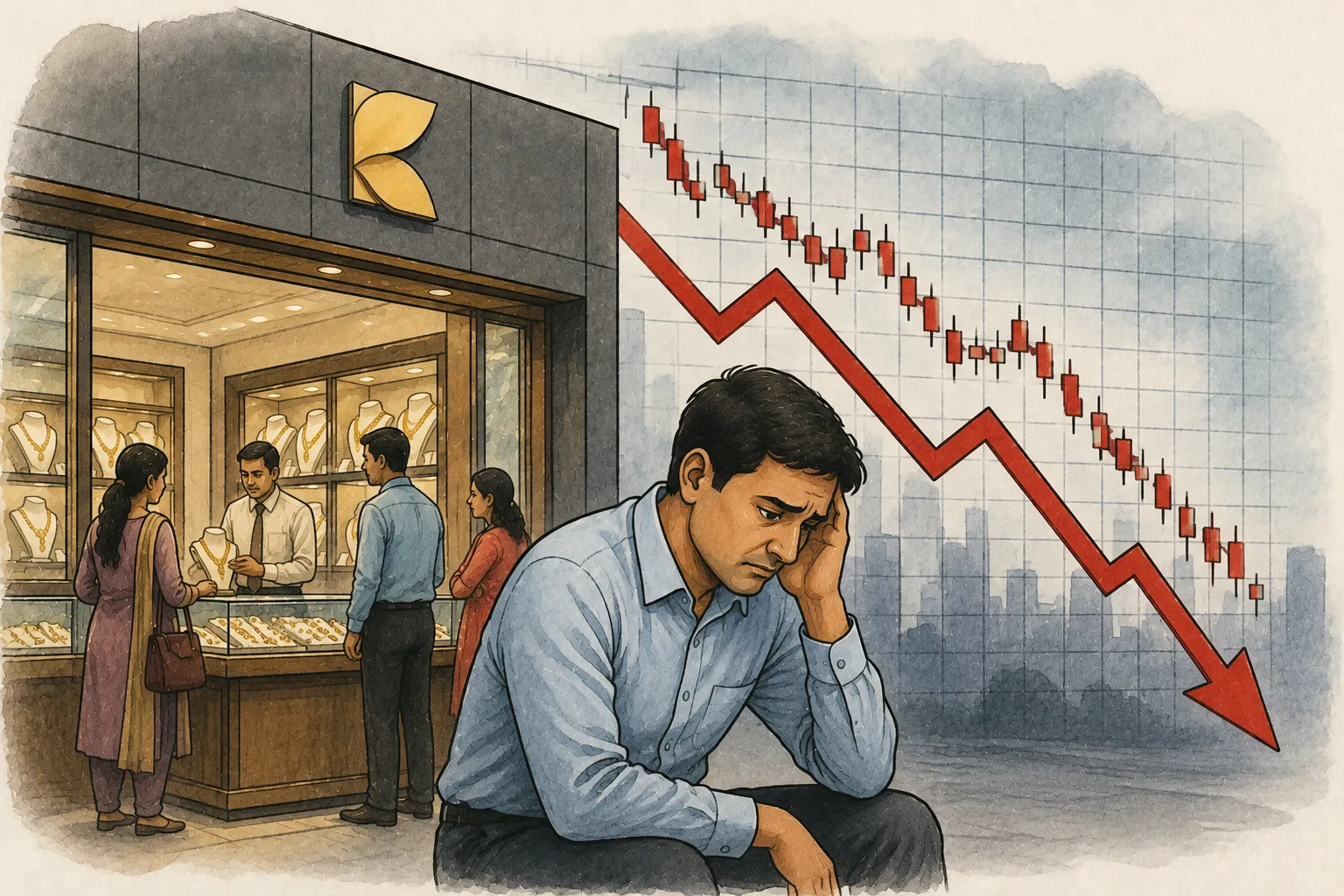
Kalyan Jewellers shares extended their decline on 2 September, falling for a fourth straight session as investors weighed jewellery-demand concerns against strong reported sales growth. The stock’s intraday weakness reflected broader caution across Indian jewellery counters.
Kalyan Jewellers India Ltd shares remained under pressure on Tuesday, 2 September, extending a four-session decline amid concerns over discretionary gold demand and the possible margin implications of a changing sales mix.
The NSE-listed stock, traded under the symbol KALYANKJIL, fell as much as 2.22% intraday to ₹560.90. At 10:14 am, it was quoted at ₹565.15, down 1.48% for the session. Reports tracking the live market move said the stock had declined 10.4% over the preceding four trading sessions.
These were intraday figures, not the final closing data for the day. The latest move therefore reflected continuing selling pressure rather than a fresh corporate announcement from the branded jewellery retailer.
Four sessions of pressure after September 1 sell-off
The 2 September decline followed a sharper fall in Kalyan Jewellers shares on 1 September. The stock had closed 4.66% lower at ₹573 on the NSE that day, when several listed jewellery companies came under pressure.
The immediate sector backdrop was Prime Minister Narendra Modi’s renewed appeal to avoid buying gold unless necessary, made as part of the wider Swadeshi and Vocal for Local messaging. The appeal was not a legal restriction on gold purchases, nor was it a company-specific action involving Kalyan Jewellers.
Still, it brought renewed attention to the outlook for discretionary jewellery spending. Consumer gold buying is influenced by household sentiment, bullion prices, wedding demand, festive purchases and consumers’ willingness to exchange old ornaments for new jewellery.
The reaction was seen across other jewellery stocks on 1 September. Titan Company ended 1.03% lower, Thangamayil Jewellery declined 1.86%, and BlueStone Jewellery and Lifestyle fell 0.51%. Senco Gold, however, rose 1.19%, indicating that sector sentiment was weak but not uniform.
For Kalyan Jewellers, the four-session fall appears to be a market reassessment of the operating environment for jewellery retailers, rather than confirmation of a new adverse company development.
Why revenue growth did not shield the stock
The recent share-price movement highlights why investors often look beyond headline revenue growth. A company can report strong sales growth while its stock comes under pressure if the market becomes concerned about demand quality, sales mix or margins.
Reports citing a Nuvama Institutional Equities sector review said Kalyan Jewellers recorded 47% year-on-year revenue growth in the first quarter of FY27, with same-store sales growth estimated at 28%. These figures were cited in market reports but require confirmation through the company’s official results filing or investor presentation.
The distinction is important in the jewellery sector. Higher gold prices may increase the rupee value of jewellery transactions and raise reported sales even when underlying volume growth is less certain. Investors may therefore focus on whether revenue growth is supported by sustained customer demand rather than only a higher value of gold sold.

Transaction mix is another area under scrutiny. Old-gold exchange and recycling can support jewellery purchases, particularly when bullion prices are high. However, a greater contribution from exchange-linked transactions may have different margin characteristics from sales associated with fresh gold purchases.
The market’s concern, therefore, is not necessarily about whether Kalyan Jewellers can generate sales. It is whether sales growth can continue alongside stable margins, resilient consumer demand and favourable operating conditions.
Gold import duty remains part of the backdrop
The current weakness in jewellery stocks is also unfolding in a changed bullion-policy environment.
India raised the effective import duty on gold and silver to 15% from 6% in May 2026. The revised levy comprises 10% basic customs duty and 5% Agriculture Infrastructure and Development Cess, effective from 13 May.
This duty change was not a new development on 2 September and should not be viewed as the immediate reason for the latest fall in Kalyan Jewellers shares. However, it remains relevant background for jewellery retailers because import costs, domestic gold prices and buyer behaviour can shape demand patterns.
At elevated gold prices, consumers may choose to defer purchases, opt for lower-weight jewellery or exchange existing ornaments. Such shifts can affect the mix and quality of sales growth, even when the value of overall transactions remains high.
Also Read: TCS Reportedly Wins ₹2,000-Crore Best Buy GCC Mandate
Corporate dates and indicators to track
Investors will now watch official company disclosures for indications on sales mix, same-store performance, profitability and customer demand. Management commentary on old-gold exchange activity, store expansion and consumer footfall may also help clarify whether the stock’s decline is mainly a short-term sentiment reaction or reflects deeper sector concerns.
Gold-price movement and jewellery demand during the upcoming wedding and festive purchase periods will remain important. Share-price trends in Titan, Thangamayil Jewellery, BlueStone and Senco Gold may also offer clues on whether pressure across the sector is broadening or easing.
Kalyan Jewellers has scheduled its 18th annual general meeting for 19 September. Shareholders on record as of 12 September will be eligible for the proposed final dividend of ₹2.50 per share, subject to shareholder approval. These corporate-calendar events are relevant for shareholders but were not identified as the trigger for the recent decline.