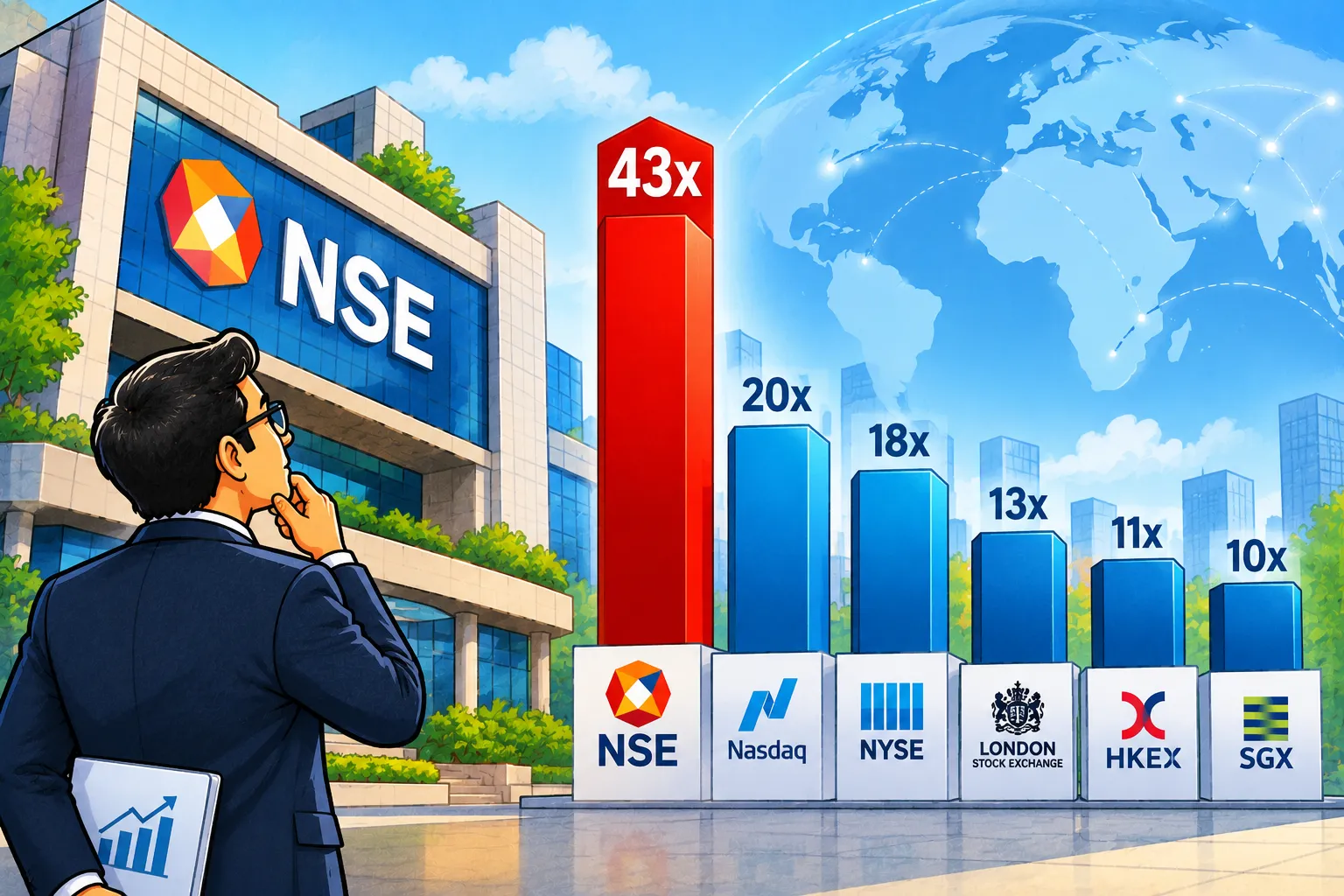
NSE now ranks as the world's seventh-largest exchange by market capitalisation at ₹4.44 trillion, but at 43 times FY26 earnings it trades at a steep premium to global peers like Nasdaq and ICE, prompting a split among analysts over whether the valuation is justified.
Where NSE Now Sits
National Stock Exchange of India, which debuted on the BSE last week, is valued at ₹4.44 trillion at its current price of ₹1,792 per share, a valuation ahead of Titan, Infosys and Kotak Mahindra Bank, and nearly three-and-a-half times that of BSE. NSE made a lacklustre debut at ₹1,800 per share against its ₹1,785 issue price, notably below where the stock had been trading near ₹2,000 in unlisted markets just days earlier. It is now the seventh-largest exchange in the world by market capitalisation.
At 43 times FY26 earnings, NSE's valuation multiple is exceeded only by Titan (73x) and Adani Enterprises (100x) among comparable large Indian names, though it remains cheaper than its smaller domestic peer, BSE.
The Bull Case
Brokerage Macquarie noted in a report last week that while NSE trades at a 65 per cent P/E premium to international exchanges, it delivers roughly 60 per cent higher growth and returns, supported by India's structural financialisation tailwinds, the long-term trend of more household savings moving into capital markets. Macquarie has set a 12-month target of ₹1,965 for the stock, implying 9.6 per cent upside from Friday's close of ₹1,792.65.
Vikas Gupta, CEO at OmniScience Capital, said he does not view regulatory actions as a major risk to NSE's trading volumes, arguing any impact tends to be transitory, with volumes normalising over a few quarters as India's financial-market penetration continues to deepen. Sham Chandak, head of institutional equities at Elios Financial Services, argued the premium over global peers is justified by NSE's superior margins, sustained high growth over a long period, and dominant market share in Indian equity trading.
Also Read: NRI Deposits Surge 678% To $36.2 Billion On RBI's Swap Window

The Bear Case
A PL research report projects NSE will grow earnings at 11 per cent annually over the next three years. At 43 times earnings, that growth rate looks expensive when set against global peers: Intercontinental Exchange (ICE, on NYSE) is expected to grow at 12 per cent and Nasdaq at 13 per cent over the same period, yet both trade at roughly 25 times earnings, little more than half NSE's multiple for comparable or better growth.
Aniruddha Sarkar, co-founder and CIO at Equinova Investment Managers, put it plainly: "We believe the positives are largely priced into NSE, despite its attractive long-term structural story, supported by rising financial inclusion." Some analysts remain sceptical about the exchange's near-term growth prospects specifically, separate from the longer-term structural argument.
Disclaimer: Views, price targets and growth projections cited from Macquarie, PL, and named analysts belong to those firms and individuals and are not endorsed by this publication; investors should conduct their own due diligence.
Why It Matters
The split between Macquarie's bullish 65 per cent premium justified by higher growth argument and the PL-based comparison showing NSE priced at nearly double the multiple of faster-growing global peers captures a genuine, unresolved debate about whether India's structural financialisation story is enough to justify NSE's valuation, or whether the stock's muted debut already reflects the market's own uncertainty on that question.