
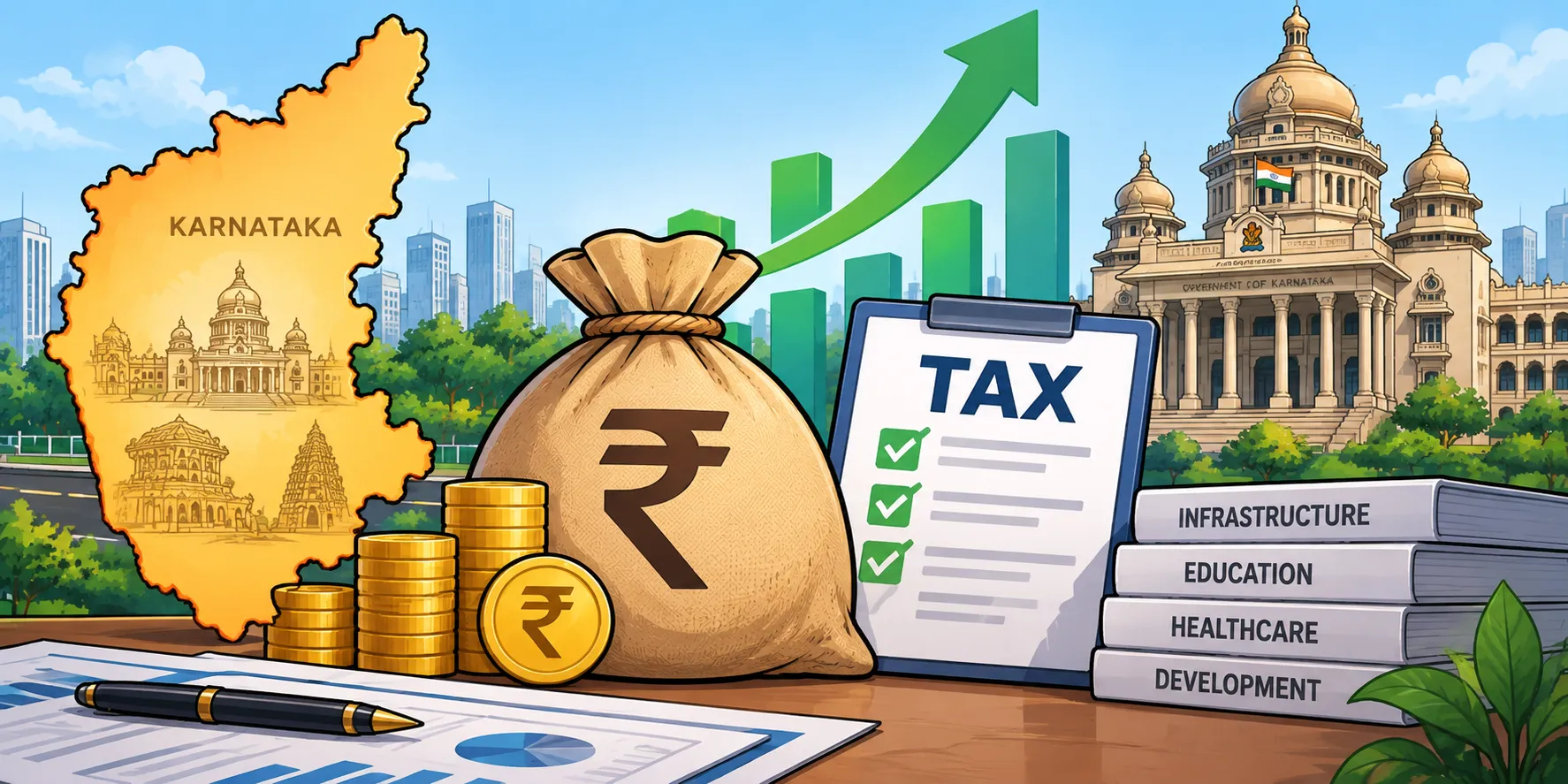
Karnataka has emerged as the second-largest direct-tax contributor after the Mumbai region, according to Vidisha Kalra, Principal Chief Commissioner of Income Tax for the Karnataka and Goa Region.
Speaking at a Bengaluru conference on 8 September 2026, Kalra said the state’s net direct-tax collections were nearing ₹1.25 lakh crore. The conference was organised by the Bangalore Chamber of Industry and Commerce and focused on the New Income Tax Act, 2025, and related rules.
The collection figure is a direct-tax measure. It should not be treated as Karnataka state-government revenue, a stock-market trigger, or evidence of the earnings performance of a particular listed company or sector.
The reported ranking is against Mumbai region
The available disclosure identifies Karnataka as second after the Mumbai region. It does not establish a comparison with the entire state of Maharashtra, and no direct-tax collection amount for the Mumbai region was disclosed in the available material.
The reporting also does not specify whether the nearly ₹1.25 lakh crore figure covers a financial year, calendar year or another reporting period. That limitation should be kept in mind when comparing the number with other tax data.
Kalra attributed Karnataka’s direct-tax performance to strong economic activity, voluntary compliance, sector-focused outreach, digital initiatives and support from tax professionals and industry bodies. These factors were her assessment of the state’s tax performance; the disclosures did not provide a sector-wise split of the collections.
The ranking offers a broad view of taxable formal-sector activity in Karnataka. It does not establish a state GDP ranking, a measure of corporate profitability, or a direct implication for the Nifty, Sensex or individual stocks.
Direct taxes and GST cannot be combined
Direct-tax collections are administered by the Union government and are distinct from state-level revenue receipts. Karnataka’s direct-tax data should therefore be considered separately from the state’s GST collections.
A Press Information Bureau release previously reported that Karnataka collected ₹1.63 lakh crore in GST during FY 2025–26 and ranked second nationally on that indirect-tax measure. GST and direct taxes are separate streams, even though both may reflect the scale of formal economic activity.
The ₹1.63 lakh crore GST figure should not be added to the nearly ₹1.25 lakh crore direct-tax figure. The two measures have different bases, collection mechanisms and fiscal destinations.
For the Indian market, the latest update is macroeconomic context rather than a tradeable event. It provides no company-wise, sector-wise or stock-specific collection break-up.

CBDT cites broader compliance progress
Central Board of Direct Taxes member Pallavi Agarwal shared national tax-administration data at the same event. She said more than 1.32 crore updated returns had been filed over the preceding four years, generating ₹16,083 crore in additional tax payments under the Income Tax Department’s NUDGE campaign.
These figures relate to national tax compliance and are not specific to Karnataka. The Income Tax Department also added 49 lakh first-time filers by 31 July 2026, according to Agarwal.
She said the department interfaces with around eight crore taxpayers and receives nearly 600 crore transaction details through tax deducted at source, Statements of Financial Transactions and the Annual Information Statement.
The department has conducted 304 outreach programmes across India since April 2026 to explain the Income Tax Act, 2025, related rules and redesigned return forms. Its AI-enabled virtual assistant, Kar Sathi, recorded 54.83 lakh sessions for queries on the new law, rules and forms.
Also Read: Prasol Chemicals IPO Opens With ₹80 Crore Fresh Issue
Filing and processing data under the new framework
For Assessment Year 2026–27, more than 97% of ITR-1 returns and over 95% of ITR-2 returns were filed under the new tax regime, Agarwal said.
The data points to high use of the new regime among filers in these two categories. However, the figures are aggregate statistics and should not be treated as a personal tax-planning recommendation, since an individual’s outcome can vary according to income, deductions, exemptions and other circumstances.
The Income Tax Department’s guidance states that the Income Tax Act, 2025 applies to tax years beginning on or after 1 April 2026. Proceedings relating to tax years before that date continue under the Income-tax Act, 1961.
Agarwal also said that, of returns filed up to 31 August 2026, around 2.54 crore returns, or 32.48%, were processed within one day. Refunds had been issued for around 65 lakh returns.
The Karnataka collection update and the CBDT’s national data together underline the tax department’s focus on expanding compliance, digital engagement and faster processing. Karnataka’s nearly ₹1.25 lakh crore contribution remains the central development, but it should be read as a fiscal and formal-economy indicator rather than a direct measure of stock-market performance or Karnataka government finances.