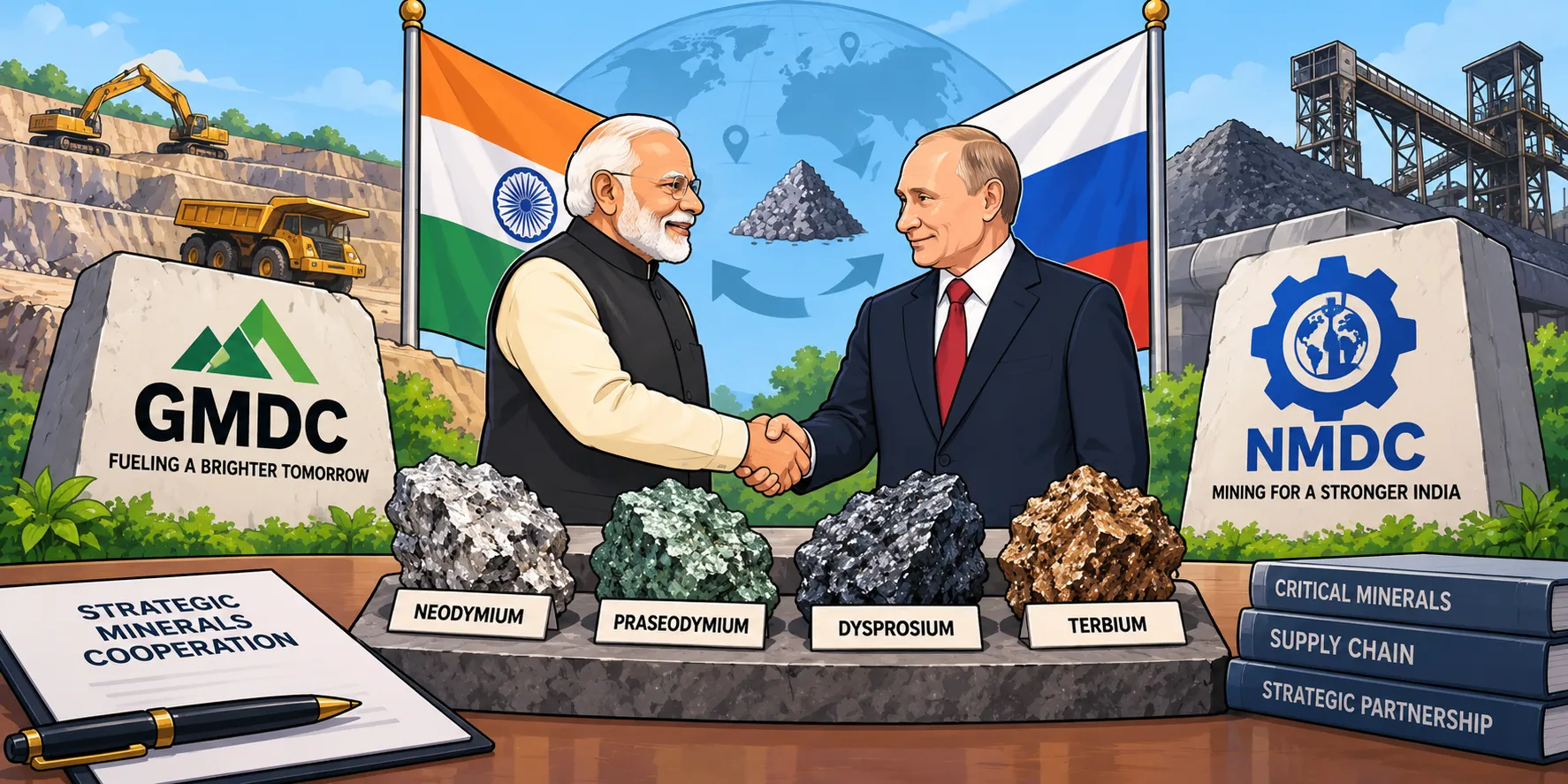
Reports on 8 September 2026 said India and Russia are discussing potential cooperation in rare-earth exploration and deep-processing metallurgical technologies. The development has revived interest in India’s push to strengthen domestic capabilities across the critical-minerals value chain.
However, no official India-Russia rare-earth agreement, commercial contract, investment commitment, project award or technology-transfer arrangement has been verified in the available public material. There is also no confirmed Russia-linked transaction involving Gujarat Mineral Development Corporation Ltd, or GMDC, and NMDC Ltd.
That distinction is central to the current market context. The reported bilateral discussions are a policy and strategic-minerals development, not a confirmed commercial milestone for either listed mining company.
GMDC and NMDC have an older Gujarat-focused MoU
GMDC and NMDC signed a memorandum of understanding on 16 March 2026 to explore collaboration in rare-earth elements and associated minerals.
GMDC is a Government of Gujarat enterprise, while NMDC is a Government of India Navratna public sector undertaking. Both companies are listed mining entities, and their March agreement has drawn attention as rare-earth supply-chain discussions gain prominence.
The MoU is focused on assessing the potential development of an integrated rare-earth value chain in Gujarat. It is centred on GMDC’s Ambadungar rare-earth deposit and covers possible work across exploration, mining, beneficiation, processing and downstream applications.
The agreement also refers to technical collaboration, knowledge exchange, technical evaluation, project development and possible business structures. It does not disclose a final project design, investment amount, funding source, ownership structure or commercial operating plan.
An MoU is not a project approval
The GMDC-NMDC arrangement remains exploratory. The March disclosure does not confirm that the companies have begun commercial mining, mineral processing, separation, manufacturing or sales activity at Ambadungar.
It also does not announce a capital-expenditure plan, a production target, a commissioning schedule, a mineable reserve, a processing facility, a customer contract or a definitive joint venture.
Similarly, the reported India-Russia discussions do not establish that GMDC or NMDC will receive Russian technology, funding, mineral access or project participation. No official disclosure reviewed for this story identifies either company as a party to a bilateral India-Russia rare-earth transaction.
For investors, the distinction matters because rare-earth development involves several stages. Exploration identifies and evaluates mineral potential; mining extracts material; beneficiation and processing improve and separate mineral content; and downstream applications can include specialised components and manufacturing.
A policy conversation or exploratory MoU may be relevant to the long-term strategic-minerals theme, but it should not be interpreted as immediate revenue, production or earnings visibility for GMDC or NMDC.

India’s ₹7,280 crore magnet-manufacturing push
The broader policy backdrop is more concrete. In November 2025, the Union Cabinet approved the Scheme to Promote Manufacturing of Sintered Rare Earth Permanent Magnets with an outlay of ₹7,280 crore.
The scheme aims to establish 6,000 metric tonnes per annum of integrated rare-earth permanent-magnet manufacturing capacity in India. It is intended to strengthen domestic capabilities in a strategically important part of the rare-earth value chain.
Rare-earth permanent magnets are relevant to supply chains used in areas such as electric mobility, renewable energy and defence equipment. The policy focus extends beyond raw-material exploration to processing and downstream manufacturing.
However, the scheme is national in scope. The available Ministry of Mines material does not name GMDC, NMDC or the Ambadungar deposit as beneficiaries. It also does not announce financial assistance for the GMDC-NMDC MoU.
Union Budget 2026–27 separately announced Rare Earth Corridors in Odisha, Kerala, Andhra Pradesh and Tamil Nadu to support mining, processing, research and manufacturing linked to rare-earth elements. Gujarat is not among the four states named in that policy announcement.
Also Read: Karnataka Nears ₹1.25 Lakh Crore in Direct Tax Collections
What could turn the theme into a business update
The next meaningful milestones would need to come through official government announcements or stock-exchange filings.
Investors tracking GMDC and NMDC should look for:
- A formal India-Russia statement identifying the scope, participating entities, financing or technology arrangements.
- A definitive agreement or project structure disclosed by GMDC or NMDC.
- Updates on technical assessment or development plans for Ambadungar.
- Details of capital expenditure, regulatory approvals, processing capability or commercial timelines.
- Ministry of Mines announcements on implementation of the ₹7,280 crore permanent-magnet scheme.
- Any confirmed allocation, licensing, environmental approval, mining development or downstream manufacturing plan.
No verified GMDC or NMDC share-price movement, trading-volume change or exchange-specific market reaction is available in the current information. Therefore, the development should not be treated as evidence of a confirmed stock catalyst.
The India-Russia discussions have made rare earths a renewed policy theme for Indian markets. But the verified position remains measured: GMDC and NMDC have a March 2026 exploratory MoU for Gujarat’s Ambadungar deposit, while any direct commercial outcome from bilateral talks would require a later, formal announcement.