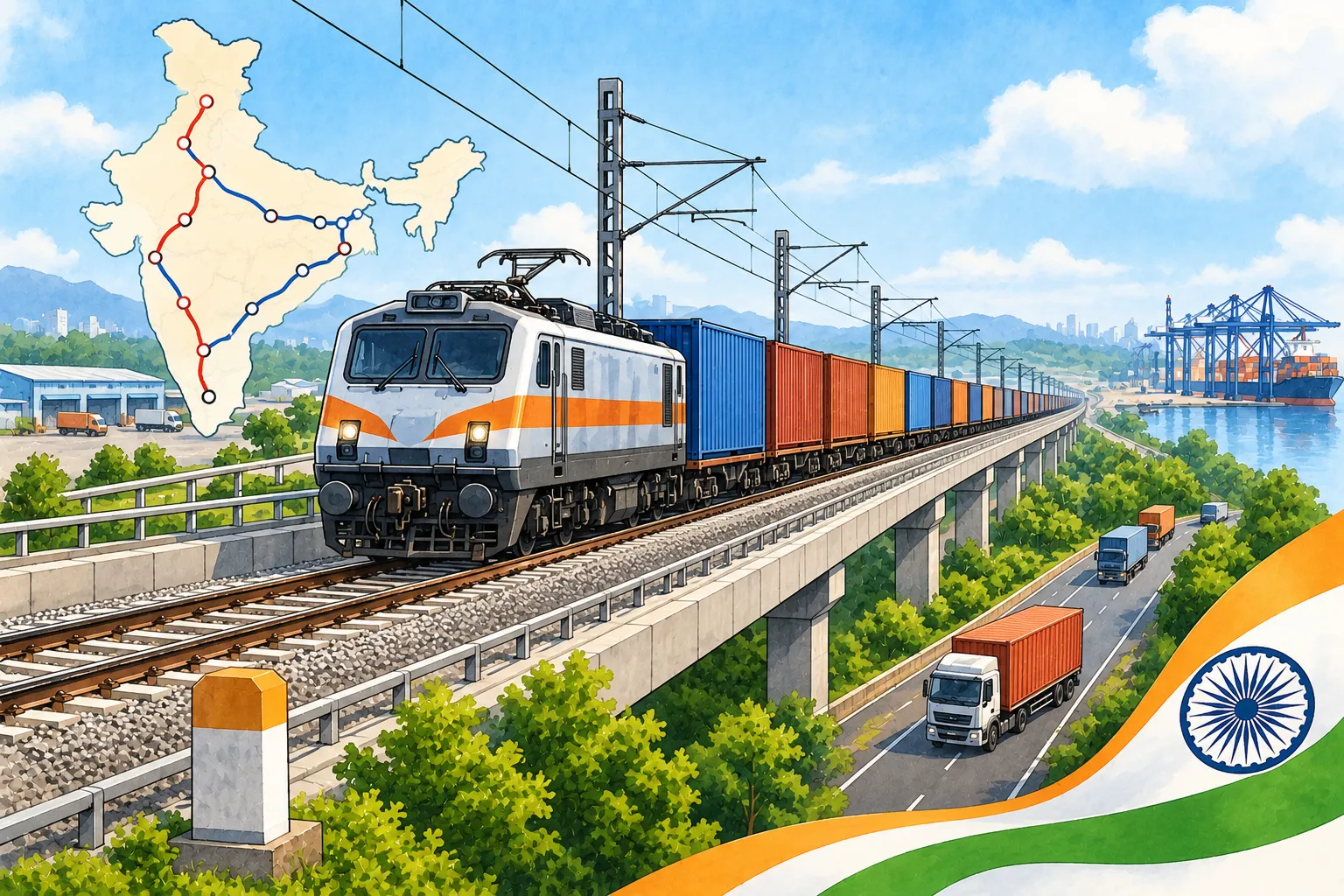
Prime Minister Narendra Modi is scheduled to dedicate three Western Dedicated Freight Corridor sections on September 8. The ₹20,700-crore project package is expected to complete India’s DFC network and create direct freight rail connectivity to JNPA.
Prime Minister Narendra Modi is scheduled to visit Gujarat and Maharashtra on September 8, with a major freight-logistics milestone planned in Vadodara: the dedication of three sections of the Western Dedicated Freight Corridor, or WDFC.
The three sections cover 326 route kilometres and were developed at a cost of more than ₹20,700 crore. According to the Prime Minister’s Office, their commissioning is expected to make India’s Dedicated Freight Corridor network operational across its entire length.
The WDFC programme is part of a broader package of projects worth more than ₹35,000 crore that are scheduled to be inaugurated, dedicated or have foundation stones laid in Vadodara. As of September 7, the programme remains a scheduled event; the corridor sections have not yet been officially dedicated.
The three WDFC stretches planned for dedication
The freight corridor sections scheduled for dedication are:
- New Sanand (North)–New Makarpura
- New Umbergaon–New Saphale
- New Saphale–New JNPT
The New Saphale–New JNPT stretch is particularly significant because it is expected to provide direct freight rail connectivity to Jawaharlal Nehru Port Authority, or JNPA. The port is an important gateway for India’s export-import cargo, making the rail link a key element of the government’s logistics strategy.
Freight train services are also scheduled to be flagged off from New Sanand (North), New Makarpura, New Umbergaon and New JNPT.
The planned dedication represents the most material economic element of the September 8 programme because it would complete the Dedicated Freight Corridor network, according to the PMO. The wider project announcement includes rail, road, urban-development and renewable-energy works, but the WDFC milestone carries the clearest connection to national freight movement and trade logistics.
Direct JNPA access is the key trade link
The government has said the completed WDFC links are intended to speed up EXIM cargo movement, improve industrial-to-port connectivity, lower logistics costs and reduce pressure on Mumbai’s railway network.
Those benefits should be viewed as expected outcomes rather than confirmed operating results. Freight capacity use, service reliability, tariff structures, last-mile links and adoption by cargo owners will determine the eventual economic impact after the sections begin operating.
Still, a direct rail route to JNPA could be strategically important for manufacturing and export supply chains. Better freight access between industrial areas and the port may support more predictable cargo movement and deeper integration between rail and maritime logistics.
For the Indian market, however, this remains a structural infrastructure development rather than a verified near-term equity-market trigger. The official announcement does not identify a listed company receiving a new order, reporting revenue or securing a contract from the WDFC package.
What the wider ₹35,000-crore programme includes
The planned Vadodara programme extends beyond dedicated freight rail infrastructure.

The government is scheduled to lay foundation stones for railway projects spanning 329 km and costing more than ₹9,700 crore. These include the Vadodara–Ratlam third and fourth railway lines, the Miyagam Karjan–Choranda–Malsar gauge-conversion project, and doubling of the Vishwamitri–Dabhoi route.
Three National Highway projects worth around ₹1,780 crore are also scheduled. These include six-laning on the Kamrej–Chalthan stretch of NH-48, road structures on the Vadodara–Surat section of NH-48, and grade-separated infrastructure on NH-53.
Separately, Gujarat government projects worth around ₹2,600 crore are included in the programme. The identified proposals include Vadodara Urban Development Authority Ring Road Phase II and a 110 MW floating solar project at Kadana Dam.
The combination of freight rail, conventional rail upgrades, roads, urban infrastructure and renewable energy reflects the breadth of public-capital expenditure activity. Yet project values should not be treated as immediate revenue or order-book additions for listed businesses without separate disclosures about contractors, agencies, funding or execution.
What investors can and cannot infer
The scheduled WDFC dedication is relevant to investors following India’s infrastructure cycle, rail logistics, port connectivity and export competitiveness. A fully operational DFC network could support the long-term movement of freight across major industrial and trade corridors.
The available information does not support naming particular railway, port, logistics, construction, solar or fintech stocks as beneficiaries. It also does not establish a specific impact on corporate earnings, cargo volumes, transport costs or valuations.
No stock-specific movement, Nifty or Sensex reaction, exchange filing, regulatory decision or corporate announcement has been verified in connection with the September 8 programme. Readers using a demat account for share market investing should therefore view the development as broader policy and infrastructure context, rather than as a standalone basis for stock market trading.
Also Read: NBFC credit hits 16.7% of GDP; RBI flags asset-quality risk
Global Fintech Fest follows the Vadodara event
After the Vadodara programme, Modi is scheduled to inaugurate Global Fintech Fest 2026 in Mumbai at around 5:45 pm on September 8.
The seventh edition of the event is scheduled from September 8 to 11 at Jio World Centre in Mumbai. Its stated themes include financial technology, artificial intelligence, tokenisation, programmable finance and inclusive financial systems.
The event may be relevant for financial-services and fintech-sector watchers if it produces formal policy announcements, partnerships, product launches or investment commitments. As of September 7, though, no RBI, SEBI or government regulatory decision linked to Global Fintech Fest 2026 has been announced.
For now, the scheduled WDFC dedication remains the principal development to watch: a major step in the government’s freight-logistics infrastructure plan, with its eventual market significance dependent on execution and operational outcomes rather than an immediate verified stock-market reaction.