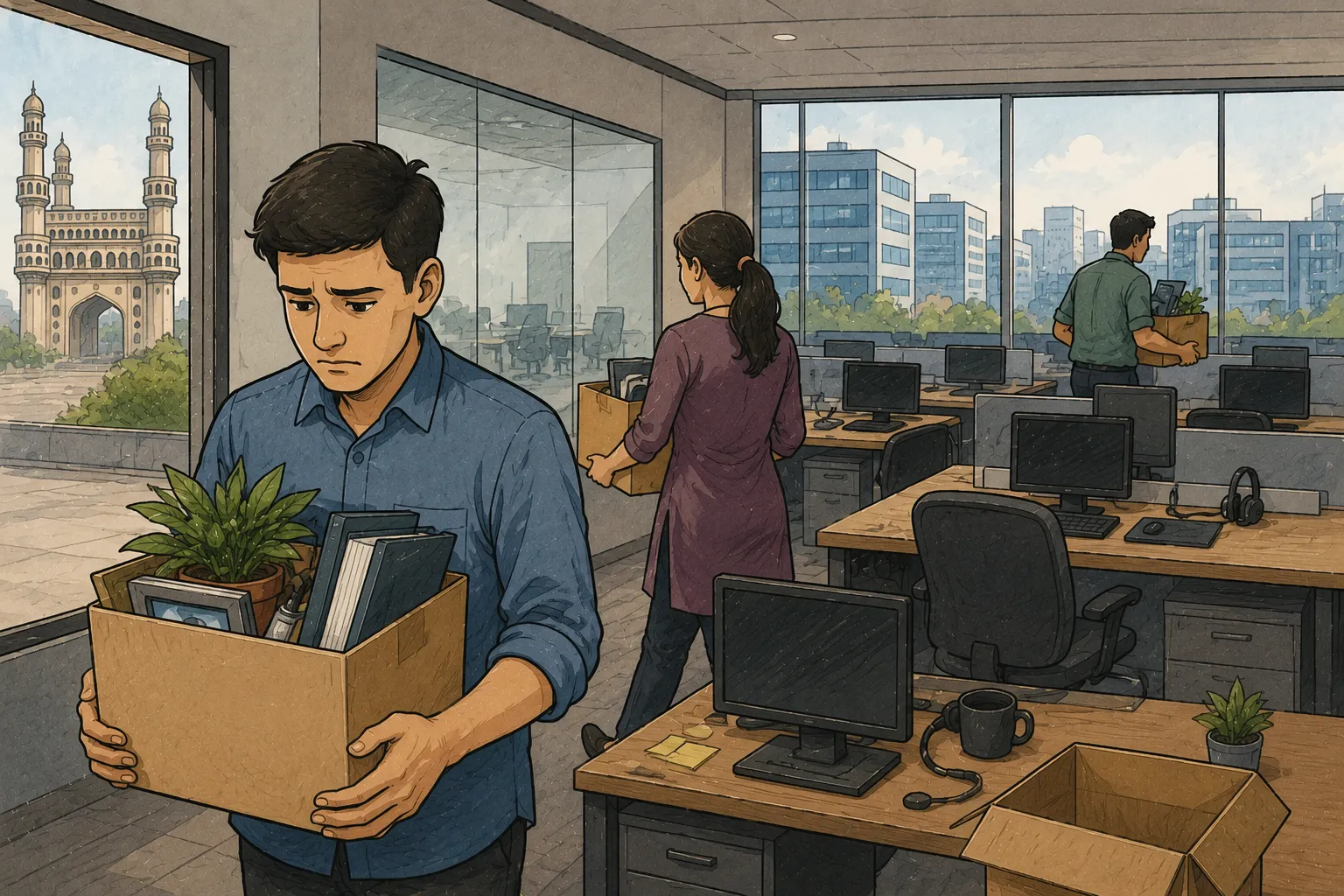
Eternal, the parent company of Zomato and Blinkit, has shut down its food delivery arm's customer support operations in Hyderabad and let go of around 240 employees, consolidating its in-house support functions at its Gurugram headquarters as part of a broader restructuring.
What Happened In Hyderabad
Zomato informed the affected employees of the workforce reduction on August 31, with the company confirming the closure of its Hyderabad customer support centre. Following the shutdown, Zomato's remaining in-house customer support team will be consolidated in Gurugram, meaning the company is not exiting the customer support function altogether, just centralising it in one location. According to reports, affected employees will receive their August salary along with severance equivalent to four months' pay, which includes contractual notice pay and a one-time settlement component.
The company has also been increasing its reliance on external outsourcing partners for customer-care work over the past six months, a trend that appears to have accelerated with the Hyderabad closure. Reports characterise the move as part of a restructuring of Zomato's customer support strategy rather than a purely cost-driven exercise, though the outcome for the roughly 240 affected employees is the same either way.
Not Zomato's First Round Of Job Cuts
This is not an isolated event in Zomato's recent history. The company had previously cut around 500-600 junior-level roles across Gurugram and Hyderabad in April 2025, a reduction the company attributed at the time to AI-led automation of customer support functions. The recurrence of job cuts in the same function suggests the company continues to lean on automation and outsourcing to manage its customer support cost base, even as its core food delivery and quick-commerce businesses have scaled significantly.
A Separate Policy Move: Dishes With Analogue Dairy
In a separate announcement, Zomato has told restaurant partners on its platform that dishes containing analogue dairy products, non-dairy substitutes formulated to mimic milk-based ingredients, will need to either be reformulated with natural dairy or removed from menus, with the company warning of delisting for restaurants that do not comply. Eateries have been directed to transition affected items to natural dairy products or drop them from their listings altogether.
While unrelated to the layoffs in terms of direct cause, both developments reflect Zomato's broader pattern of platform-level policy tightening across its restaurant and delivery ecosystem, alongside its ongoing internal cost and structure changes.
Why Job Cuts At Food-Delivery Platforms Draw Market Attention
Workforce reductions at consumer internet companies like Zomato tend to draw disproportionate market and media attention relative to their financial materiality, largely because they are read as a signal of management's confidence in near-term growth and margin trajectory. A support-function layoff tied to automation and outsourcing is generally viewed differently by markets than a broad-based layoff tied to slowing revenue, since the former is framed as an efficiency measure rather than a demand problem.
Eternal shares have historically been sensitive to headlines involving restructuring at Zomato and Blinkit, given the scrutiny both segments receive from analysts tracking the company's path to sustained profitability across its food delivery, quick-commerce and other businesses. Investors and analysts will likely look for confirmation in Eternal's next quarterly results of whether this restructuring translates into a measurable cost saving in the company's customer support and operations expense line.

Broader Context: A Tough Year For Consumer Internet Jobs
Zomato's Hyderabad closure adds to a difficult year for India's consumer internet and startup ecosystem on the employment front. Several social networking and quick-commerce startups have shut down entirely in 2026, and layoffs, whether tied to automation, restructuring or funding pressure, have remained a recurring theme across the sector even as headline valuations for larger, listed players like Eternal have generally held up.
Separately, the broader consumer and beverage space has also seen distress signals this week, with glass manufacturer Hindusthan National Glass and Industries reportedly serving a default notice on alcobev brand Bira91 over alleged unpaid dues, underscoring that cost pressure and restructuring are not confined to any single vertical within India's consumer economy right now.
Also Read: India's New Closing Auction Faces First Major MSCI Test
What This Means For Eternal Shareholders
For existing and prospective Eternal shareholders, the practical takeaway is less about the headline job-cut number and more about whether the underlying automation and outsourcing shift meaningfully improves the unit economics of the food delivery business over coming quarters. Shareholders holding Eternal shares in their demat account should watch upcoming quarterly disclosures for commentary on customer support costs as a share of food delivery revenue, since that is where any efficiency gain from this restructuring would eventually show up.
Investors tracking Eternal alongside other consumer internet and quick-commerce names can do so through an online trading platform that provides real-time price and volume data across the sector.
This report is for informational purposes only and does not constitute investment advice. Employee-count figures are as reported and may be revised by the company.