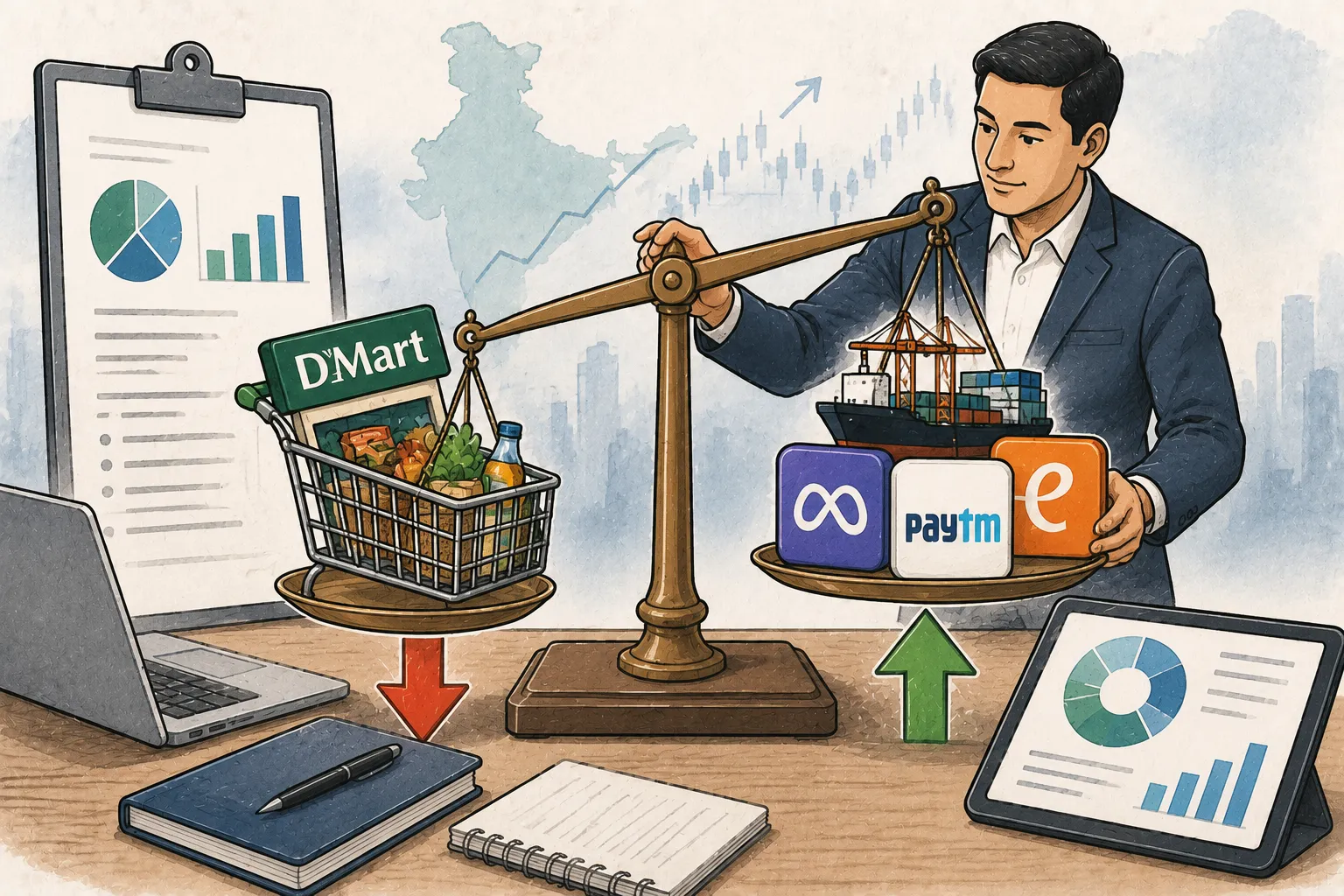
Bernstein has refreshed its 13-stock India model portfolio, adding Adani Ports, Eternal and Paytm while exiting DMart. The global brokerage retained its Nifty 50 target at 26,000 and framed the rotation through a new "distortion economy" lens.
A three-in, one-out rotation with the Nifty target held at 26,000
The rejig, executed at the close of the Q1 FY27 earnings season on 18 August 2026 and detailed in Bernstein's India Strategy note dated 19 August 2026, tilts the model portfolio toward ports and logistics, quick commerce and digital payments and away from defensive value retail.
Lead India strategist Venugopal Garre, Managing Director at Bernstein, has kept the brokerage's Nifty 50 target unchanged at 26,000, implying roughly 8% upside from the levels around which the note was published. The message running through the rejig is straightforward: index returns are likely to be modest, and the alpha will need to come from bottom-up stock picks.
The refreshed portfolio remains, in Bernstein's own words, "somewhat financials-heavy", a reflection of its coverage universe and stock-specific conviction rather than a deliberate sector bet.
The three new entrants and Bernstein's stated catalysts
Bernstein has laid out a distinct catalyst behind each addition. The numbers below are Bernstein's entry prices on 18 August 2026 and its stated target prices.
| Stock | Sector | Entry price (18 Aug 2026) | Bernstein target | CYTD return | P/E (FY27E) |
| Adani Ports | Industrials | ₹1,677.10 | ₹1,973 | 13% | 26.0x |
| Eternal (Zomato) | Consumer | ₹317.10 | ₹350 | 12% | 312.5x |
| Paytm | Financials | ₹1,559.40 | ₹2,200 | 21% | 67.3x |
Adani Ports returns to the portfolio after a recent correction. Bernstein has cited the company's healthy balance sheet, pricing power and the growth runway from its international business as the main pull.
Eternal, the parent of Zomato, marks a clear reversal from Bernstein's earlier stance. The brokerage had previously stayed on the sidelines because of quick-commerce competition and the prospect of a rival listing. It now believes competitive pressure is easing, and that EBITDA and net order value (NOV) growth is running ahead of estimates alongside steady food-delivery expansion.
Paytm has been added as a momentum-cum-catalyst call. Bernstein sees the likely finalisation of a UPI merchant discount rate (MDR) in the coming months as a potential re-rating trigger for net payment margins, while the core payments business is expected to cushion downside risk.
Why DMart was dropped after two years
Avenue Supermarts had been part of Bernstein's model portfolio since August 2024. The brokerage has now removed it at ₹3,997.60 below its original entry price of ₹4,958.60 closing a roughly two-year position.
The rationale is a mix of stock-level caution and macro discomfort:
- Rising quick-commerce threat to DMart's urban consumption base.
- Weak agricultural sowing trends clouding the near-term rural consumption picture.
- Wholesale Price Index above 8% for four consecutive months, keeping wholesale inflation sticky.
- No decisive direction on the urban-value retail model as competitive dynamics evolve.
The exit is best read as a change in preference while Bernstein waits for greater visibility on company-specific earnings drivers, rather than a structural call against organised retail.

The 'distortion economy' thesis anchoring the rejig
The layer that separates this rejig from a routine model-portfolio update is Bernstein's follow-up strategy note titled "The distortion economy and the beneficiaries." The note argues that a large share of India's headline earnings strength is being amplified by eight policy distortions — including GST cuts, production-linked incentive (PLI) subsidies, rural cash transfers, capital controls, and FCNR-driven support for the rupee via borrowed dollars.
Bernstein's point is not that these forces are bad for markets, but that investors must identify who benefits while they last. As the brokerage puts it: "Distortions can persist far longer than investors expect. The key is not to fight them, but to identify who benefits while they last."
Two names in the portfolio fit this thesis most directly:
- Eternal: Bernstein argues that large-scale welfare transfers are expanding the pool of workers willing to take flexible, gig-based jobs, with urban low-skilled delivery work paying better than factory work. Eternal and Delhivery are explicitly named as beneficiaries of that expanding gig-labour pool.
- Titan: Linked to the Centre's once-in-a-decade wage revision effective January 2026, expected to channel more than USD 20 billion a year in transfers to central employees, with state governments likely to follow. Bernstein sees this supporting premium and discretionary consumption as the earlier GST-cut boost fades.
The full 13-stock portfolio
The reshuffled model portfolio spans industrials, utilities, consumer, financials, healthcare, asset management and automobiles.
| Stock | Sector | CYTD return |
| Adani Ports | Industrials | 13% |
| L&T | Industrials | -2% |
| NTPC | Utilities | 0% |
| Eternal | Consumer | 12% |
| Titan | Consumer | 25% |
| PFC | Financials | 3% |
| Paytm | Financials | 21% |
| Axis Bank | Financials | -3% |
| Zydus Lifesciences | Healthcare | 23% |
| HDFC Bank | Financials | -27% |
| Home First Finance | Financials | 7% |
| Nuvama Wealth | Asset management | 18% |
| M&M | Automobile | -9% |
The list includes both outperformers and laggards, underlining the bottom-up character of the book.
Also Read: Ola Electric Jumps as S1Z Scooter Debuts With Bharat Cell
The earnings backdrop shaping the call
The rejig sits on a mixed Q1 FY27 earnings print. NSE 200 earnings growth slowed to 8% from 12.5% in the March quarter. Nifty 50 earnings, by contrast, accelerated to 12.8%, while Nifty Next 50 earnings contracted about 4%, dragged by losses at oil marketing companies and weakness across parts of banking and cement.
Bernstein has flagged that stripping out OMCs would lift NSE 200 growth to 19% for the June quarter, and excluding metals too would put it at 15% — though the brokerage has explicitly said it does not favour excluding sectors merely to present a cleaner growth narrative.
Tougher base effects are expected to kick in from September 2026, making further broad-based earnings upgrades harder. That, combined with richer SMID valuations and an expected acceleration in primary-market issuance, underpins Bernstein's decision to keep the Nifty 50 target at 26,000 and pursue returns through stock selection.
What Indian investors will watch next
Four data points now sit on the near-term watchlist: the timing and structure of any UPI MDR rollout, the January 2026 central government wage revision, the competitive shape of India's quick-commerce market, and Adani Ports' international expansion pipeline.