
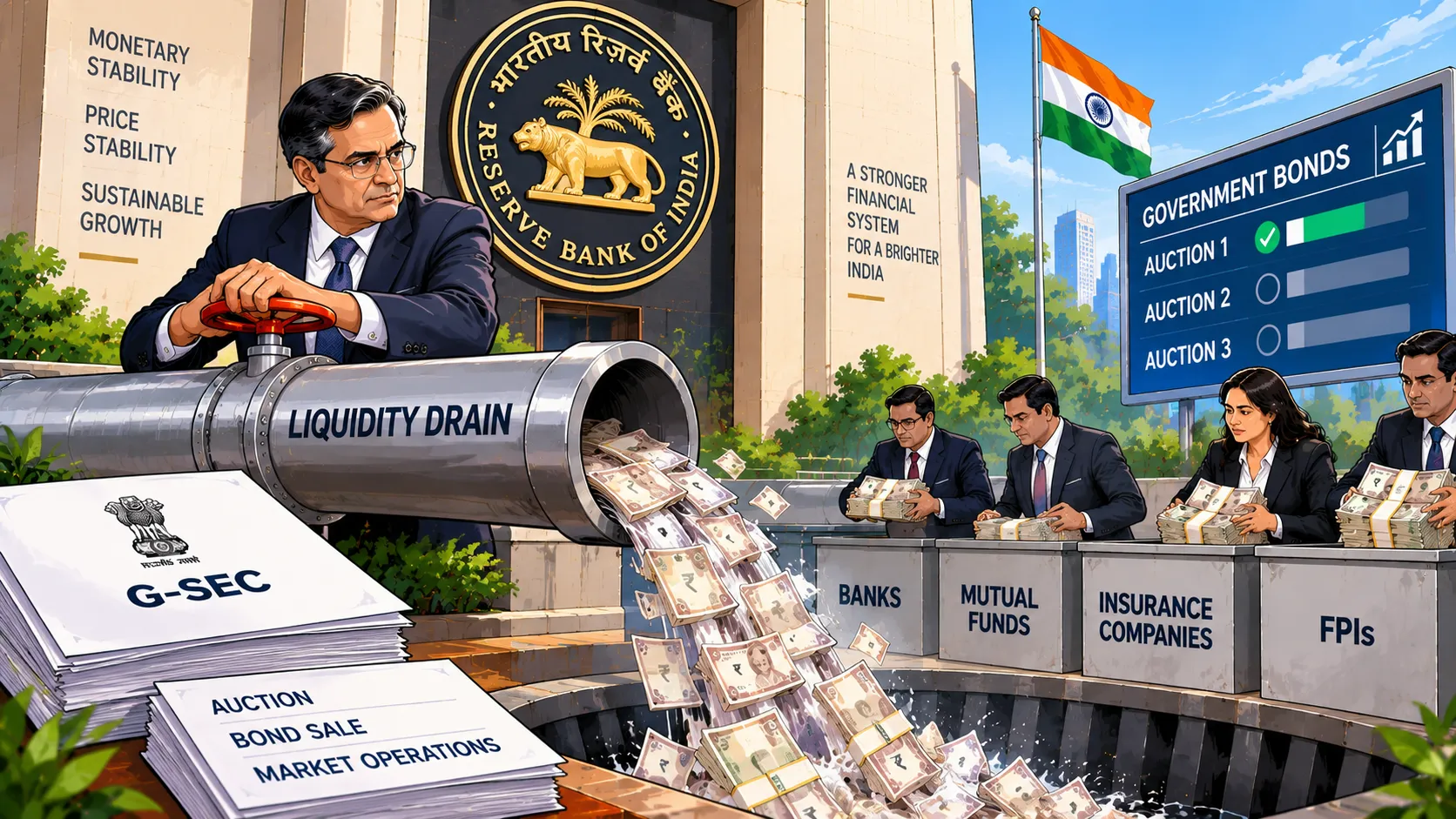
The Reserve Bank of India sold ₹50,000 crore of government securities on Thursday, the first of three open market operation sales intended to pull ₹1 trillion of surplus cash out of the banking system this month.
What the RBI Sold and at What Price
The RBI accepted bids for the entire notified amount of ₹50,000 crore in face value at its open market operation sale auction on Thursday, September 17, 2026. The central bank had offered six government securities without specifying a security-wise split, and used a multi-security auction under the multiple price method.
The auction results show where the demand concentrated:
- ₹18,840 crore was accepted in the 8.28 per cent Government Security 2032, the largest single allocation
- ₹12,645 crore was accepted in the 5.77 per cent Government Security 2030
- Cut-off yields across the six securities ranged from 6.6007 per cent to 7.0090 per cent
- The 8.28 per cent GS 2032 carried the highest cut-off yield at 7.0090 per cent
Market participants described demand as robust even though the cut-off price came in higher than expected. One dealer at a primary dealership said there was some selling immediately after the cut-off was announced, followed by short covering later in the day as crude oil prices fell.
Why Banks Chose Bonds Over the RBI's Reverse Repo Window
The more revealing detail is what banks did not do. The RBI's longer-tenure variable rate reverse repo auctions have been meeting muted demand, with banks reluctant to lock funds away for 30 days.
Several banks preferred to buy government bonds at current yields instead of parking money through the reverse repo route. As the same dealer put it, the levels on offer were attractive enough that banks were ready to buy bonds rather than go for the variable rate reverse repo.
That preference is the reason the RBI switched instruments. Reverse repo auctions absorb transient money for a fixed term. An outright bond sale takes the cash out durably, because the buyer pays for a security it now owns.
Where Liquidity and Money Market Rates Stand
Net liquidity in the banking system was in surplus of ₹7.37 trillion on Wednesday, according to RBI data, down sharply from ₹9.85 trillion on Tuesday.
Durable liquidity is the larger number and the one the RBI is targeting. It stood at ₹10.66 trillion as of August 31 and is estimated to have risen to about ₹14 trillion by the middle of September.
The overnight weighted average call rate, which is the operating target of monetary policy, settled at 5.05 per cent on Thursday against 5.02 per cent on Wednesday. That keeps it close to the Standing Deposit Facility rate and below the policy repo rate of 5.25 per cent. Draining liquidity is how the RBI intends to push the call rate back up towards the repo rate.

The yield on the benchmark 10-year government bond settled at 7.05 per cent on Thursday, flat against the previous close. That yield had crossed 7 per cent on September 11 for the first time since June 3, 2026, when the RBI announced the bond sale programme.
The Inflow That Created the Surplus
The cash pile is the result of the RBI's own action. The central bank's special foreign currency mobilisation measures drew a record response and closed on August 31, leaving the banking system with far more rupees than it needed.
That rupee liquidity pushed short-term money market rates below the policy repo rate, which complicates the RBI's effort to keep financial conditions consistent with its stated policy stance. RBI Governor Sanjay Malhotra said on September 11 that the central bank had all options on the table to address the liquidity surge. The bond sale was announced hours later.
This is the RBI's first large net sale of government securities in two years. Its last secondary market sale was in September 2024, and through 2025 and early 2026 the central bank was doing the opposite, buying bonds and running dollar-rupee swaps to inject liquidity.
Also Read: Two Fund Houses Bought Half of LIC's ₹31,552 Crore OFS
The Two Auctions Still to Come
The September programme was announced through an RBI press note on September 11 and runs in three tranches:
| Auction date | Notified amount |
| September 17, 2026 | ₹50,000 crore |
| September 21, 2026 | ₹25,000 crore |
| September 28, 2026 | ₹25,000 crore |
Bids are submitted on the RBI's E-Kuber system between 9:30 am and 10:30 am, with results announced the same day.
Market participants said demand at the next two auctions will depend on where government bond yields are trading on those days. The RBI is expected to conduct further open market operation sales in October as well, since one month of sales will not by itself absorb a durable surplus estimated at around ₹14 trillion.
For bond investors, the practical effect is a larger supply of paper hitting the secondary market at a time when crude above $100 a barrel and a weaker rupee are already pushing yields higher.