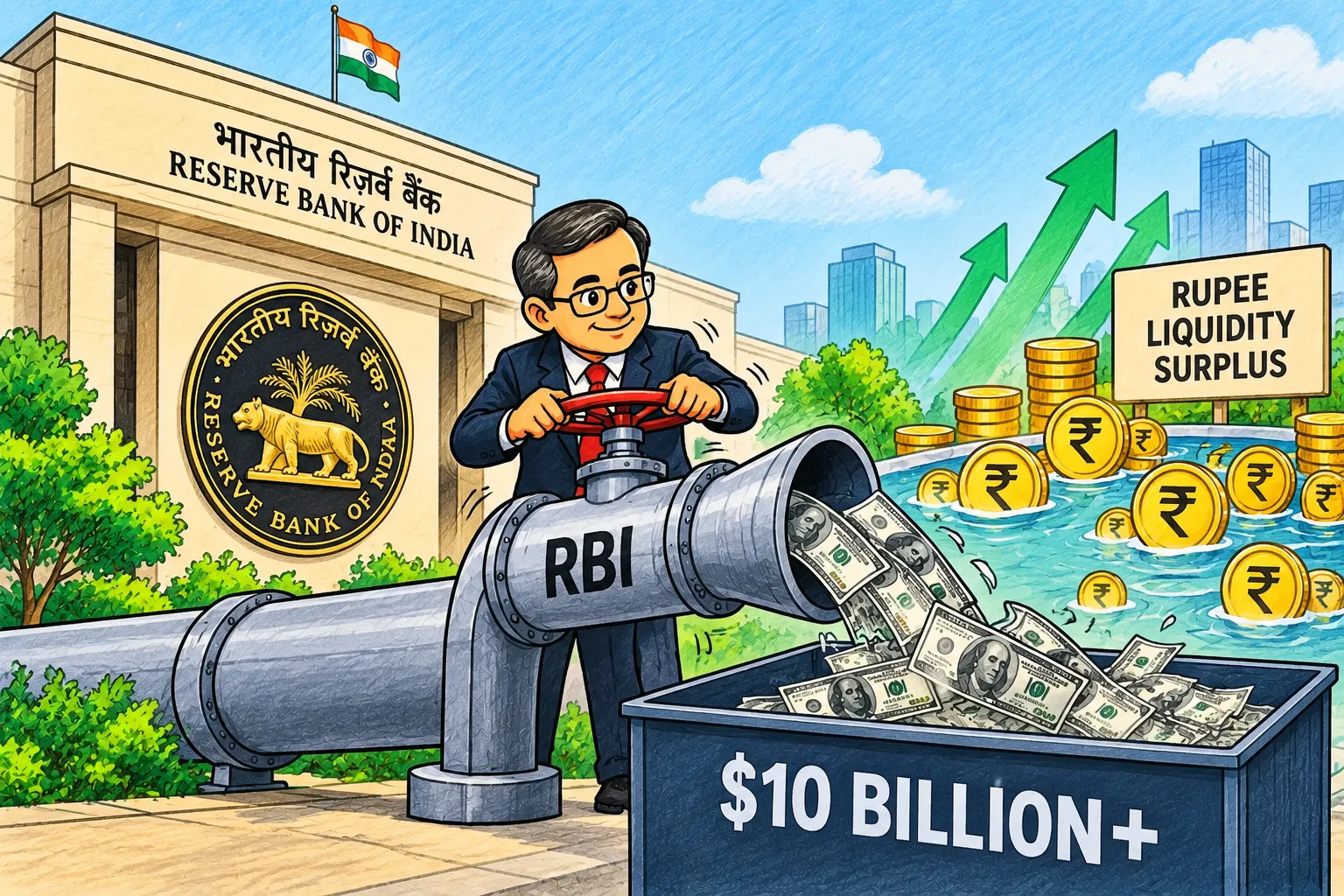
The Reserve Bank of India carried out currency swaps worth at least $10 billion over the past two weeks to pull excess rupees out of the banking system, after record foreign inflows pushed surplus liquidity to roughly ₹11 trillion earlier this month.
What The RBI Did
According to people familiar with the matter, cited by Bloomberg, India's central bank has been conducting so-called sell-buy dollar-rupee swaps with lenders over the past two weeks, with maturities ranging from about one month to roughly six months. In these transactions, the RBI sells dollars to banks in exchange for rupees, agreeing to reverse the trade at a later date. That structure effectively pulls rupees out of circulation for the life of the swap, tightening liquidity in the banking system without an outright rate move.
A spokesperson for the RBI did not respond to a request for comment on the report, so the exact figure and timing carry that caveat: this is sourced reporting rather than an RBI announcement, though the scale is corroborated by a named market economist.
Why The RBI Is Acting Now
The swaps are a response to an unusually large liquidity surplus. Measures the RBI has taken to attract foreign capital pulled in more than $140 billion, well beyond what the central bank had expected. Those inflows pushed surplus banking liquidity to a record ₹11 trillion, equivalent to about $115 billion, earlier this month.
That much surplus cash pushes down banks' borrowing costs and, left unaddressed, risks feeding inflation by making credit unusually cheap and abundant. The RBI's swap operations are aimed squarely at absorbing that excess before it works its way into broader price pressures, especially with oil prices already elevated.
Gaura Sen Gupta, chief economist at IDFC First Bank, said the RBI has been managing the liquidity build-up through a combination of bond sales and sell-buy swaps. "Without these tools, the surplus would have peaked at ₹15.5 trillion," she said, adding that the central bank may have carried out $10 billion to $15 billion of sell-buy swaps maturing within the current fiscal year, which ends March 31.

Market Reaction
The scale of the RBI's swap activity has been large enough to move market pricing directly. Rates on dollar-rupee forward contracts maturing in three to six months have climbed through September, a move traders read as reflecting the central bank's swap activity. That rise extended further on Thursday, with the six-month and one-year rates climbing about 20 basis points to their highest levels since May.
The RBI's recent swap activity is also unusually large by its own historical standards. The central bank typically conducts public swap auctions in tranches of roughly $3 billion to $5 billion; the current operation, at $10 billion or more, is a considerably bigger intervention, reflecting the scale of the surplus it is trying to manage.
Also Read: Kalpataru Projects Bags ₹2,025 Crore In Fresh Orders, Nears Half Its FY27 Target
What It Means Going Forward
For banks and money-market participants, the swaps signal that the RBI intends to keep actively managing liquidity rather than letting the surplus persist. For borrowers and depositors, tighter durable liquidity conditions could gradually feed into a modest firming of short-term borrowing costs, even without a change in the policy repo rate itself. The scale of the intervention, and IDFC First Bank's estimate of a further $10 billion to $15 billion still to come this fiscal year, suggests this is likely to remain a recurring feature of RBI operations rather than a one-off adjustment.