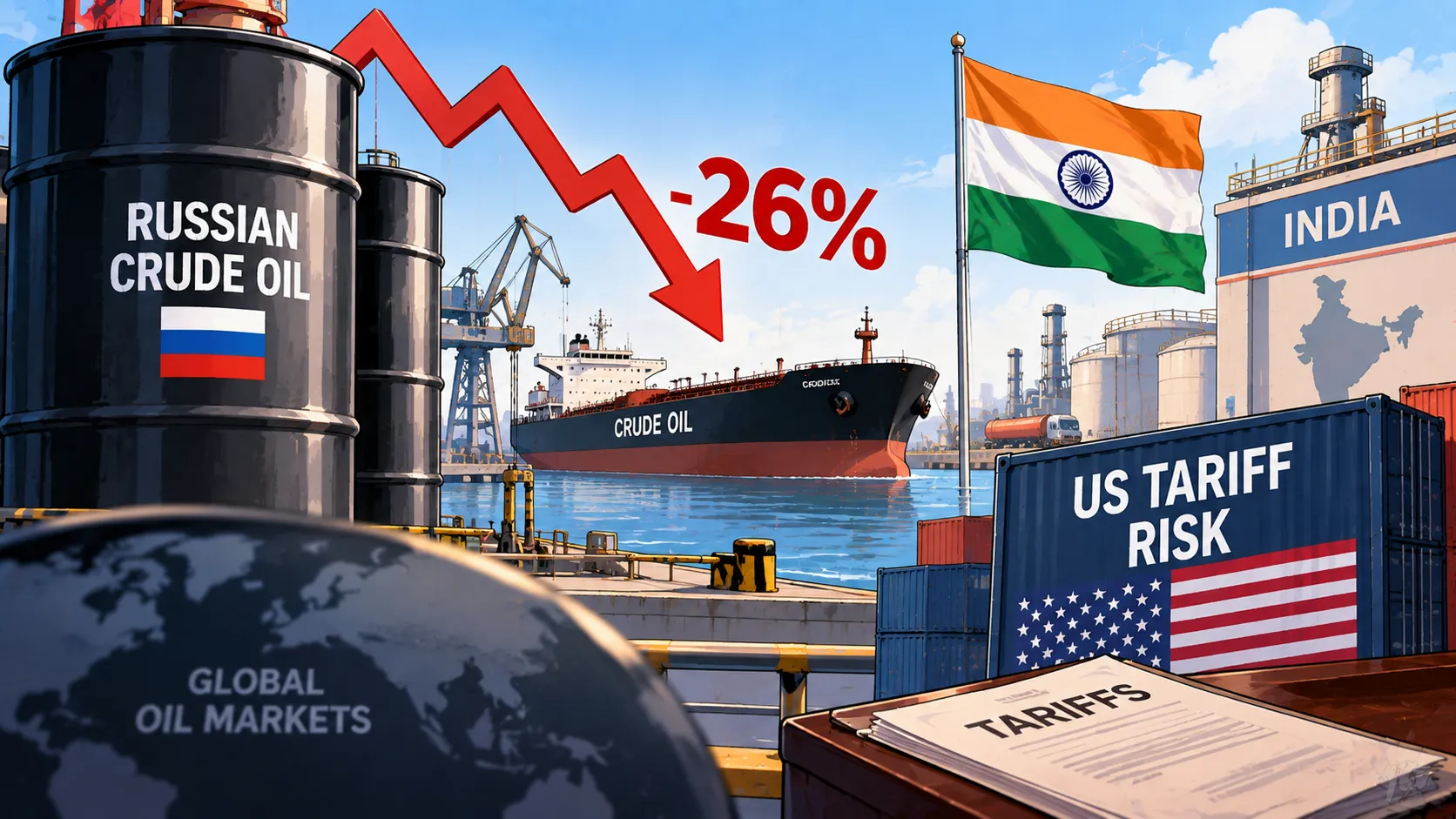
India's imports of Russian crude oil fell about 26 percent in August to roughly 2.09 million barrels a day, and could slide further in September, as refiners weigh the risk of US tariffs of up to 100 percent on major buyers of Russian energy.
Imports Decline From July's Levels
Russian seaborne crude arrivals in India fell to around 2.09 million barrels per day in August, down from 2.83 million barrels per day in July, according to data from commodity analytics firm Kpler. Russia's identifiable share of India's total crude imports consequently declined to about 44 percent in August, down from 56 percent in July, and has averaged around 39 percent so far in September.
Preliminary shipping data suggests the decline could continue, with September imports of Russian crude projected to average around 1.9 million barrels per day if current trends hold. Russia nonetheless remains India's single largest crude oil supplier by a wide margin, with the United Arab Emirates and Venezuela following as the next largest sources.
Why the Decline Is Happening Now
The drop predates the most recent US legislative action, meaning it reflects a combination of factors already in motion rather than an immediate reaction to new sanctions. Indian refiners had already been adjusting their sourcing as Middle Eastern supply routes improved and as competition for Russian barrels increased from Chinese refiners, who have been bidding aggressively using freight-advantaged shipping routes.
Purchases of Iraqi crude, for comparison, rose by roughly 25 percent to about 171,000 barrels per day in August, illustrating how Indian refiners have been diversifying their supplier base even before the latest round of US pressure over Russian oil purchases took effect.
| Metric | July 2026 | August 2026 | September 2026 (so far) |
| Russian crude imports (bpd) | About 2.83 million | About 2.09 million | Averaging about 1.95 million |
| Russia's share of India's crude imports | About 56 percent | About 44 percent | About 39 percent |
The US Tariff Threat
The decline is unfolding alongside a new US law that gives Washington expanded authority to act against major buyers of Russian energy. The US House of Representatives passed the Sanctioning Russia and Iran Act of 2026 by a vote of 262 to 159 on September 16, and President Donald Trump signed the legislation into law on September 18. The law authorises the US administration to impose tariffs of up to 100 percent on countries that continue purchasing significant volumes of Russian oil and gas, though a maximum authorised tariff does not mean such a tariff is automatically applied to any specific country, including India.
Indian refiners are reportedly preparing for the possibility that these tariffs could be applied, and have been increasing their spot market purchases from other suppliers as a hedge. India, which is separately negotiating a trade deal with Washington, has stated its firm commitment to energy security and said it will continue sourcing crude from a diverse set of sellers based on prevailing market conditions, while also cautioning that new tariffs targeting Russian oil purchases could affect the broader bilateral relationship.

A Complicated Picture on Actual Volumes
Kpler has also noted that a growing volume of crude shipments to India carries unidentified destinations or origins in trade data, which complicates efforts to measure precisely how much Russian oil is actually leaving India's crude mix even as officially tracked Russian volumes decline.
Analysts tracking the trend have generally characterised the pattern as a market normalisation following the record highs of June and July, rather than a structural break in the India-Russia oil trading relationship, with flows expected to eventually stabilise somewhere in the range of 2.0 to 2.5 million barrels per day absent a major new shock.
Also Read: Corporate Bond Market Grows to Rs 61 Lakh Crore, Says SEBI Chief
What This Means for India
Lower Russian crude imports, if sustained, could raise India's overall oil import costs, since Russian barrels have typically traded at a discount to other crude grades since Western buyers scaled back purchases following the start of the Russia-Ukraine conflict. A shift away from discounted Russian supply toward relatively costlier alternatives such as Iraqi, Gulf or Venezuelan crude could, over time, feed through to India's import bill and, potentially, domestic fuel pricing, though the exact impact will depend on how large and how sustained the shift proves to be.
For now, the changes reflect refiners actively managing supplier risk ahead of a US tariff decision that remains uncertain in both timing and scope, rather than a definitive policy shift by the Indian government itself.