
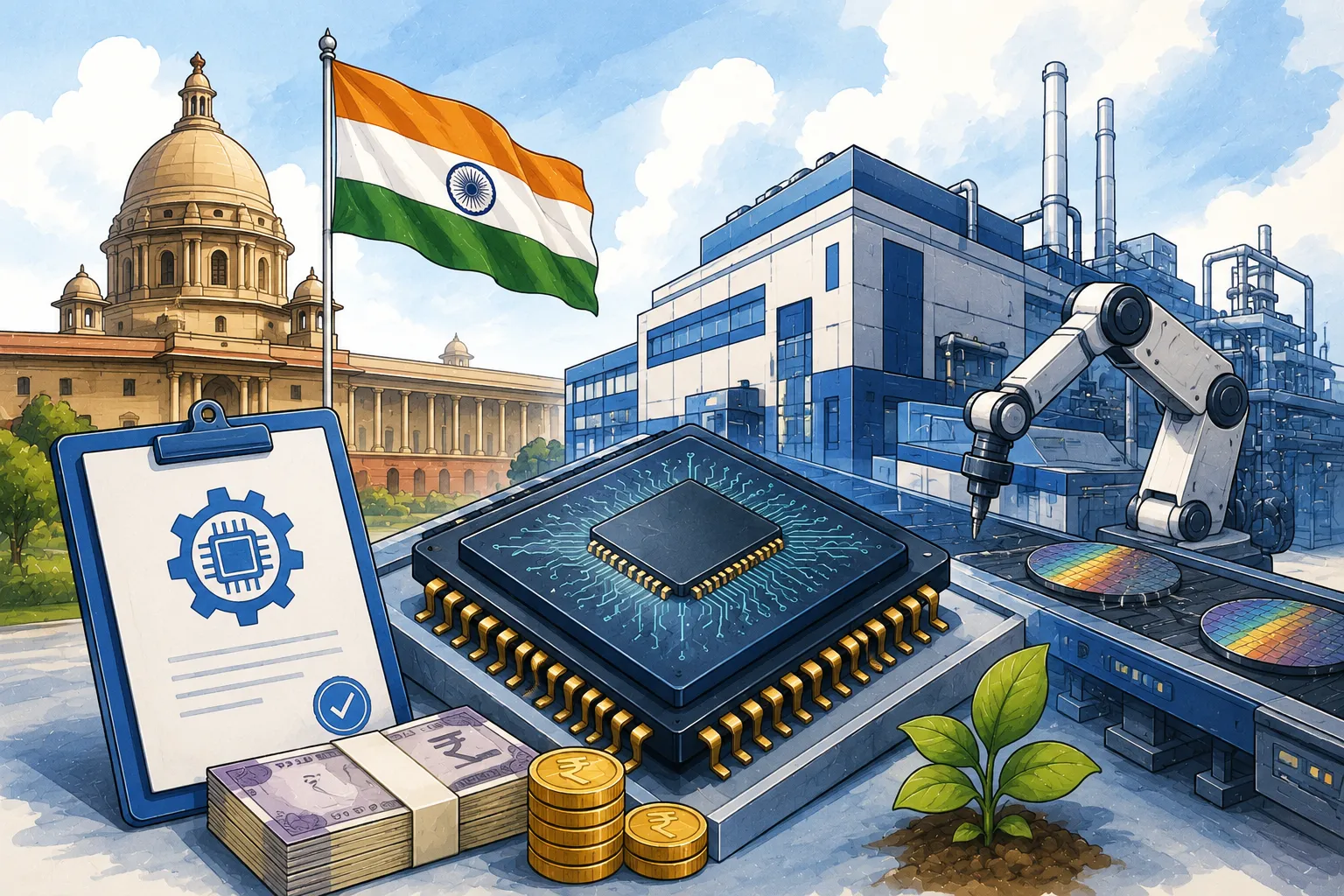
The Indian government has formally notified the Semicon 2.0 scheme with an outlay of Rs 1.27 lakh crore, expanding fiscal support across the entire semiconductor value chain just as the country's flagship chip industry event, Semicon India 2026, prepares to open in Delhi this week.
Six Pillars Of The New Scheme
Semicon 2.0 has been structured around six segments covering the complete semiconductor ecosystem: chip design by Indian companies, manufacturing of capital equipment required for chip production, semiconductor fabrication units, chip assembly, testing, marking and packaging (ATMP/OSAT), research and development, and talent development. The notification follows the Union Cabinet's approval of the programme in July and represents a significant expansion beyond the fabrication-focused approach that defined the first phase of India's semiconductor mission.
- Chip design: support for Indian companies designing semiconductors
- Capital equipment: manufacturing of equipment required for chip production
- Fabrication: semiconductor fab units
- Assembly, testing and packaging: ATMP and OSAT facilities
- Research and development
- Talent development
Building On Semicon 1.0's Progress
Under the first phase of the India Semiconductor Mission, the government committed an outlay of Rs 76,000 crore, of which roughly Rs 64,000 crore went to chip fabs, Rs 10,000 crore to a semiconductor lab, and Rs 1,000 crore to a Design-Linked Incentive scheme. Officials have said that outlay has been almost fully committed to projects, leaving room for only two or three additional small projects under the original programme.
Under Semicon 1.0, the government has approved 12 semiconductor manufacturing projects representing cumulative investment commitments of more than Rs 1.64 lakh crore, spanning one silicon fab, one silicon-carbide fab, an integrated gallium-nitride micro-LED display fab, and nine packaging units. Micron, Kaynes and CG Semi have already started commercial production under these approvals, with another facility expected to begin production later in 2026.
Government's Ambitions For The Sector
Union Electronics and IT Minister Ashwini Vaishnaw said Semicon 2.0 is expected to reduce India's dependence on foreign suppliers for a range of semiconductor-dependent products, with an ambition for categories such as sensors to eventually meet up to 100% of domestic demand. Vaishnaw has also said India could account for nearly 10% of the global semiconductor market in the coming years as its skilled talent pool, policy stability and improving ease of doing business continue to attract major investments.
The scheme's stated objective is to accelerate the creation of a comprehensive, self-reliant design and manufacturing ecosystem, providing what the government describes as sustained and consistent policy support to an industry considered strategically critical for electronics, automobiles, telecommunications, defence and other sectors.

Timing Coincides With Semicon India 2026
| Detail | Figure |
| Semicon 2.0 outlay | Rs 1.27 lakh crore |
| Semicon 1.0 outlay | Rs 76,000 crore |
| Projects approved under Semicon 1.0 | 12 projects |
| Cumulative investment committed (Semicon 1.0) | More than Rs 1.64 lakh crore |
The notification comes just ahead of Semicon India 2026, scheduled to run September 2-4 at Yashobhoomi in Delhi, which Prime Minister Narendra Modi is expected to inaugurate. This year's edition has drawn more than 350 exhibitors, compared with fewer than 200 last year, with all 1,100 booths at the venue fully booked and organisers reportedly having to turn away additional exhibitors due to space constraints, a scale that itself signals growing international interest in India's semiconductor ambitions.
Also Read: MSCI Adds Lenskart, Groww, Adani Energy To India Index
What It Means For Semiconductor-Linked Stocks
Announcements of this scale in a strategically prioritised sector tend to draw attention to listed companies with semiconductor, electronics manufacturing services (EMS) and chip-design exposure, since expanded fiscal support can improve the medium-term order pipeline and investment case for firms operating across the value chain the scheme targets, from equipment makers to fabrication and packaging players. Existing beneficiaries of Semicon 1.0, including companies involved in the approved fab, packaging and gallium-nitride projects, are likely to be watched closely for any indication of participation in the expanded Semicon 2.0 framework.
Investors tracking semiconductor and electronics-manufacturing stocks through the Semicon India 2026 event and beyond can do so via an online trading platform that provides sector-specific screening tools. Those looking to build positions in this space will need an active demat and trading account, since policy-driven sector rotations like this one often play out over several quarters rather than a single trading session.
This report is for informational purposes only and does not constitute investment advice. Scheme details are as officially notified and may be subject to further implementation guidelines.