
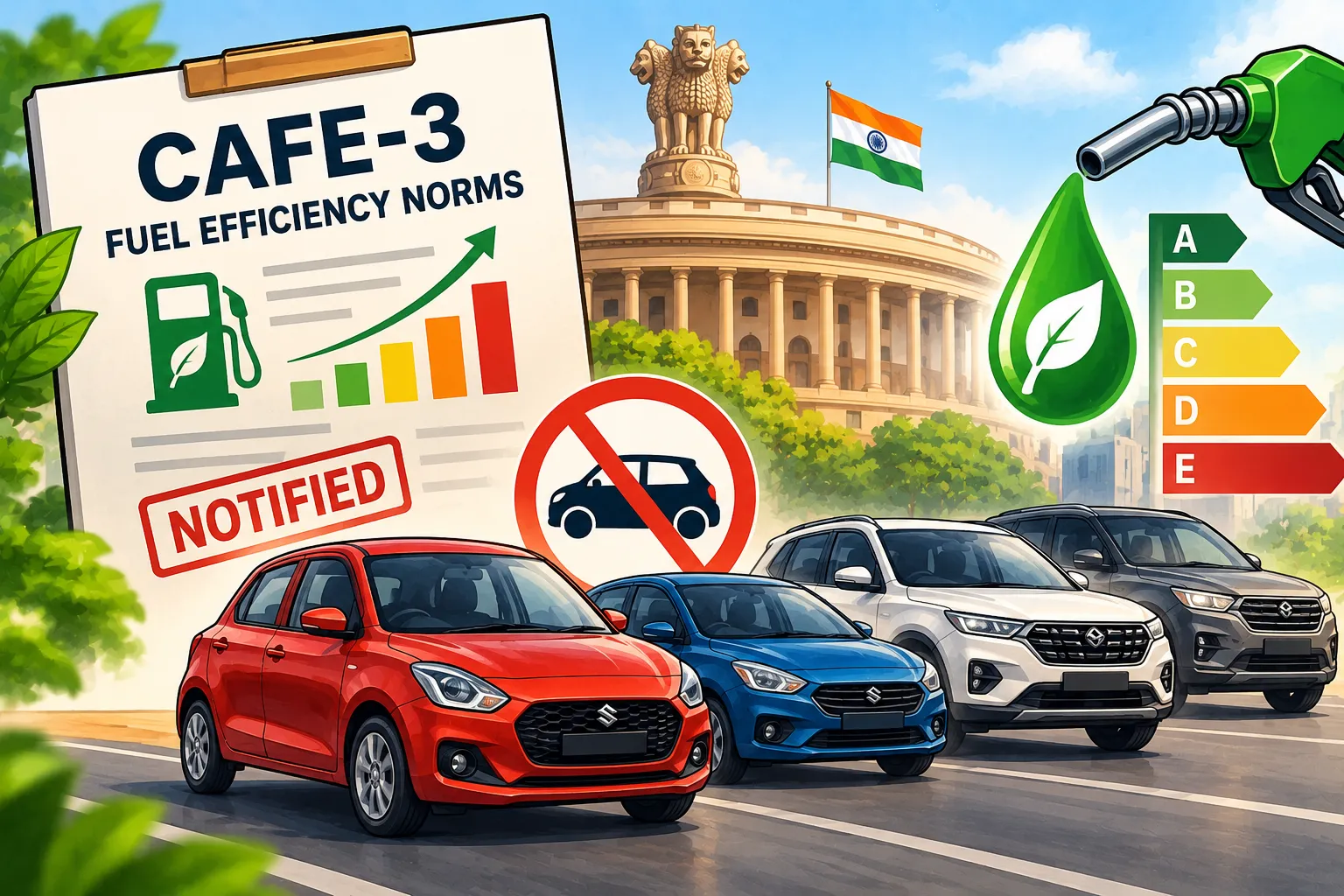
The Ministry of Power notified the final CAFE-3 fuel efficiency norms late Tuesday night, ending a 27-month industry dispute by rejecting Maruti Suzuki's push for a small-car emissions concession and instead rebuilding relief for lighter vehicles directly into the core formula.
Ending A 27-Month Fight
After multiple drafts and bitter disagreements among carmakers, the Ministry of Power notified the Corporate Average Fuel Economy (CAFE-3) norms late Tuesday night, effective April 2027 through March 2032. The final notification makes clear that small cars will not get the separate concession Maruti Suzuki India, the country's dominant small-car seller, had strongly pushed for.
The dispute traces back to the first CAFE-3 draft released by the Bureau of Energy Efficiency (BEE) in June 2024. A September 2025 draft subsequently introduced a provision giving petrol cars weighing up to 909 kg a special 3 grams-per-km (g/km) deduction when calculating a manufacturer's fleet-wide emissions performance. Other automakers, including major EV makers Tata Motors and JSW MG Motor, vehemently opposed the carve-out, arguing it would disproportionately benefit a segment dominated by one carmaker. The dispute escalated all the way to the Prime Minister's Office before the BEE issued a revised draft in July 2026 removing it.
How The Formula Was Rewritten Instead
Rather than creating a separate small-car category, the government rebuilt relief for lighter vehicles directly into the main CAFE equation, which calculates each manufacturer's carbon dioxide emissions target based on the weighted average weight of its fleet; heavier fleets get a higher permitted fuel-consumption target. The final notification shifts the reference weight from 1,170 kg (used in the September 2025 draft) to 1,229 kg, and applies a flatter weight adjustment, with the annual multiplier declining from 0.00158 in FY28 to 0.00131 in FY32.
The practical effect: a 909-kg car now gets an FY28 emissions target of about 82.8 g/km, versus roughly 76 g/km under the September 2025 formula, meaning lighter vehicles actually get more room under the final rules than the failed carve-out would have given them at the low end. At the other extreme, a 2,500-kg car gets an FY28 target of about 142.4 g/km, down from about 151.4 g/km under the September 2025 formula, a meaningfully stricter target for heavy vehicles.
The EV Incentives That Remain
The other central feature of CAFE-3 is its super-credit system, which gives manufacturers extra compliance value for selling cleaner vehicles. Under the final rules, one battery electric vehicle (BEV) counts as three vehicles when calculating a manufacturer's fleet performance; the same 3x factor applies to range-extended electric vehicles. Plug-in hybrids and flex-fuel strong hybrids get a 2.5x factor, ordinary strong hybrids get 1.6x, and flex-fuel vehicles (minimum 85% ethanol blends) get 1.1x.

This is a considerably reduced structure compared with the original June 2024 draft, which had proposed a 4x factor for BEVs, 2x for plug-in hybrids, 1.2x for strong hybrids, and a 5x factor for hydrogen fuel-cell vehicles; hydrogen vehicles do not appear in the final super-credit table at all.
Also Read: Foreign Investors Pour Record $9.5 Billion Into Indian Real Estate In Q3, Led By Data Centres
A Credit-Debit Trading System
The final rules also introduce a credit-debit passbook system per manufacturer: beating a target earns credits, missing it accumulates debits, and these can be carried forward within a compliance block (FY28-FY30 as the first three-year block, FY31-FY32 as the second). Manufacturers can trade credits with each other, and a manufacturer with a persistent deficit can buy credits directly from the BEE, at a price starting at ₹2,500 per gram of CO2 per km in FY28 and rising ₹500 annually to ₹4,500 by FY32. The trading window runs October 1-31 each year.
Why It Matters
For Maruti Suzuki, the outcome is a partial win dressed as a loss: it did not get the dedicated small-car exemption it lobbied for, but the reworked formula's flatter weight curve still delivers real relief at the lighter end of the fleet spectrum, just without singling out a category that rivals said unfairly favoured one manufacturer. For EV-focused makers like Tata Motors and JSW MG Motor, the retained but reduced super-credit structure still rewards electrification, though at a lower multiplier than originally proposed, meaning the compliance advantage of selling EVs is real but smaller than the industry's most bullish early expectations. The credit-trading mechanism, a genuinely new feature, gives the industry a market-based tool to manage compliance costs collectively rather than each manufacturer bearing its own shortfall in isolation.