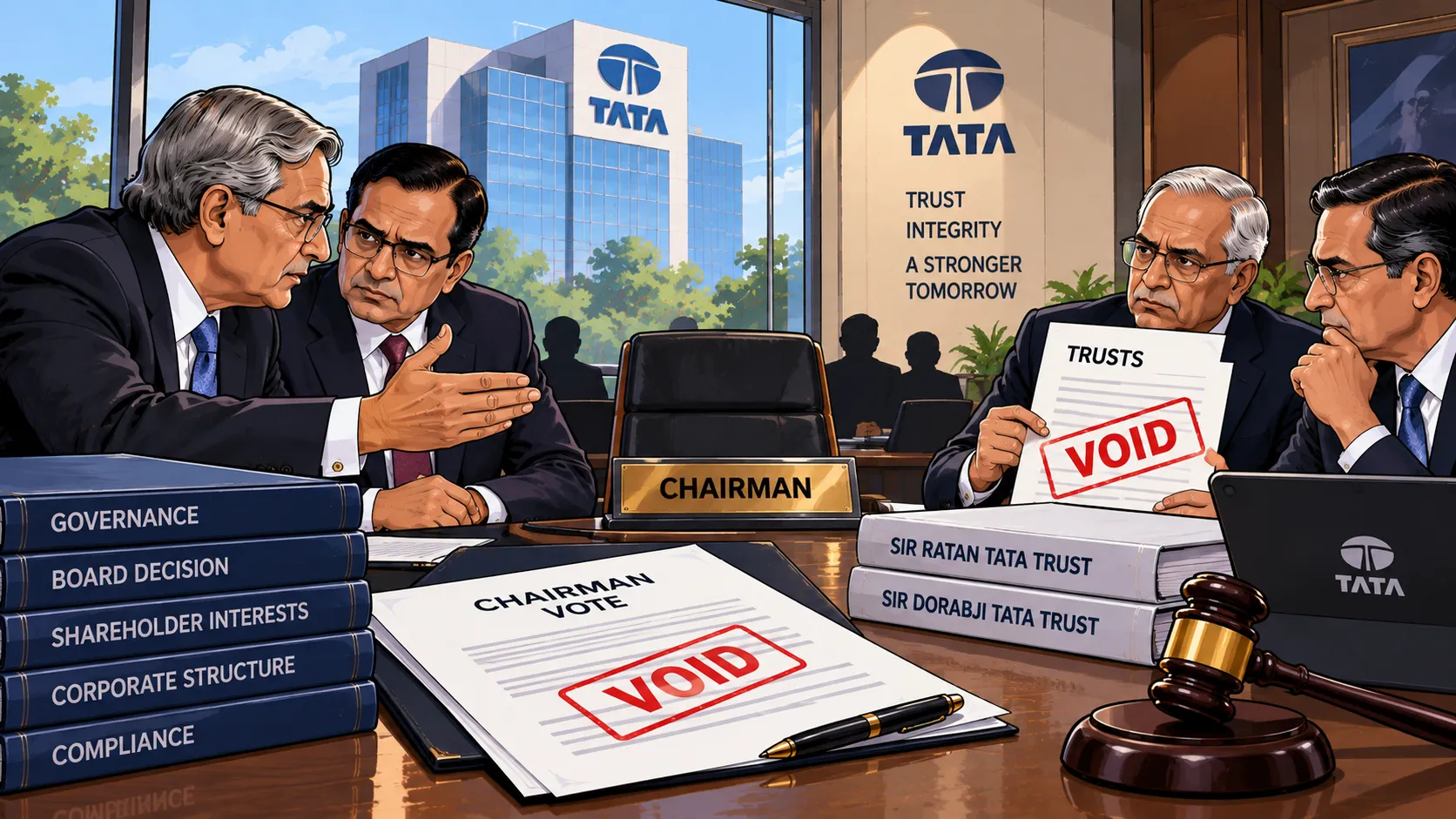
Tata Trusts said on Sunday that the Tata Sons board resolution of September 17 reappointing N Chandrasekaran as chairman is void from the outset, arguing its two nominee directors did not both support it as the Articles require.
What the Articles of Association Require
Tata Trusts, which holds about 66 per cent of Tata Sons, rests its case on two provisions of the holding company's Articles of Association, Articles 104B and 121. Those provisions require certain board decisions to carry the affirmative support of a majority of the directors nominated by the Trusts, over and above clearing the ordinary board vote.
There are two Trusts nominees on the Tata Sons board at present: Tata Trusts chairman Noel Tata and TVS Motor chairman emeritus Venu Srinivasan. At the September 17 meeting, Noel Tata voted against the reappointment and Venu Srinivasan supported it. Tata Trusts argues that a majority among two directors means two, so the 1:1 split left the affirmative-support condition unmet.
The Trusts also said the wider board tally was beside the point. The Tata Sons board had approved a fresh five-year term for Chandrasekaran by 4:1. According to the Trusts, a condition under the Articles is either satisfied or it is not, and the margin of the board vote does not change that test. The resolution, it said, has no legal effect and is void ab initio, a legal term meaning invalid from the moment it was passed.
Why the Mistry Judgment Was Invoked
Tata Trusts built part of Sunday's argument on the litigation that followed Cyrus Mistry's removal as Tata Sons chairman in 2016. The affirmative voting rights of the Trusts' nominee directors under Articles 104B and 121 were directly contested in those proceedings.
The National Company Law Appellate Tribunal had held those provisions to be oppressive, and the complainants wanted them deleted or curtailed. Tata Sons defended them as legitimate protections agreed by shareholders and as an entitlement of the majority shareholder. The Supreme Court later set aside the NCLAT finding that the Articles were oppressive.
That history is what Tata Trusts is now using against the company. A company that went to the Supreme Court to preserve a protection cannot treat the same Articles as optional, the statement argued.
The Casting Vote Question
Tata Trusts also rejected the suggestion that the nominee split amounted to a deadlock that the chairman of the meeting could resolve with a casting vote. A casting vote, it argued, is available only where board votes are equal, and it cannot substitute for the separate requirement of affirmative support from the Trusts' nominees. On its reading there was no paralysis at the meeting: the board asked a question and the Articles answered it in the negative.
Listing Pressure After the RBI Rejection
The governance dispute sits on top of an unresolved question about listing Tata Sons. The Reserve Bank of India rejected Tata Sons' application to surrender its registration as a core investment company, which keeps a public listing of the holding company in play.

Tata Trusts used Sunday's statement to push back on the argument that a listing would improve governance at Tata Sons. It said the company had voluntarily adopted several standards that apply to listed companies, including independent directors, an audit committee, a nomination and remuneration committee, rules on related-party transactions and retirement of directors by rotation, and a code to prevent insider trading. The Shapoorji Pallonji group, which holds 18.4 per cent of Tata Sons, has welcomed the listing route.
How Tata Stocks Moved Last Week
Listed Tata companies fell on Friday, September 18, as investors weighed the boardroom split. The measured damage varied by basket and by the time of day:
- Tata Chemicals, which holds 2.53 per cent of Tata Sons, dropped more than 10 per cent in its steepest single-session decline since March 2024.
- Tata Consultancy Services, Tata Motors Passenger Vehicles, Tata Investment Corporation, Tata Technologies and Tata Power also traded lower through the session.
- Estimates of the group's market-value erosion ranged from about ₹31,000 crore in early trade to roughly ₹39,000 crore across the full day.
- The Nifty Tata 25 Cap index fell 1.12 per cent on a day when the Nifty 50 was up 0.33 per cent.
The reversal was sharp because several Tata stocks had rallied in the previous session, when the board approved Chandrasekaran's fresh term and moved to comply with RBI requirements.
Also Read: Brent Holds Above $100 as Saudi Supply Fears Ease
The Legal Track From Here
Senior Supreme Court advocate Abhishek Manu Singhvi said in a social media post on Sunday that he had entered the Tata dispute, an indication that a legal process may move quickly.
Chandrasekaran's second term runs until February 2027. He had told the Tata Sons board on August 12 that he would not offer himself for a third term after the question remained unresolved for around six months. Tata Sons has said its nomination and remuneration committee later asked him unanimously to reconsider and recommended another five-year term, which he accepted.
For shareholders in the group's listed companies, the live issue is not operating performance at TCS or Tata Motors. It is the uncertainty over who settles decisions at the holding company that sits above all of them, and how long that question stays open.