
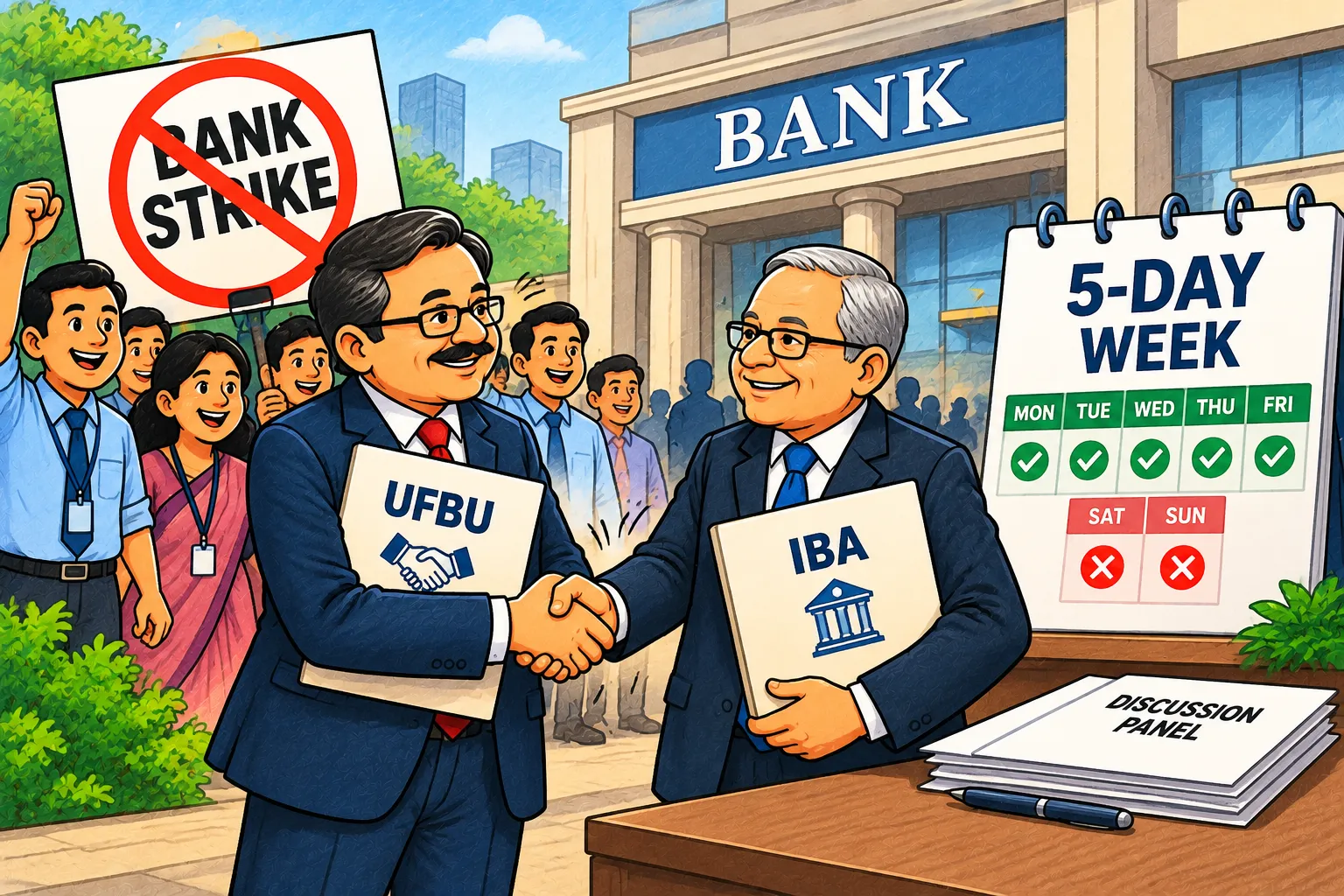
Bank unions have deferred their proposed three-day nationwide strike after a late-night meeting with the Indian Banks' Association, meaning branches will stay open through September 30 as both sides set up a committee to examine a five-day banking week.
The Strike That Didn't Happen
Banks across India remained open on Monday after the United Forum of Bank Unions (UFBU) deferred its proposed three-day nationwide strike, originally scheduled for September 28-30, following a meeting with the Indian Banks' Association (IBA) at 9:30 pm on September 27. The strike would have coincided with the half-yearly closing period, a particularly sensitive window for branch operations and settlements.
What The Unions Wanted
The UFBU had called the strike over several pending demands. The central one was implementation of a five-day banking week, with Saturday and Sunday as weekly holidays; currently, banks close only on the second and fourth Saturdays of the month, remaining open on the first and third. Unions also objected to the performance-linked incentive (PLI) scheme for Scale IV and above officers, seeking changes to address concerns the unions had raised, alongside residual issues left over from a March 8, 2024 meeting that had not been resolved.
UFBU Himachal Pradesh convenor Narendra Sharma told ANI that unions felt compelled to act because commitments made in an agreement with the government more than two-and-a-half years ago had still not been implemented.
How The Two Sides Reached A Truce
Under the understanding reached at Sunday's meeting, a high-level committee comprising both the IBA and UFBU will be formed specifically to examine the five-day week demand, exploring alternatives that could work for stakeholders including customers. On the PLI scheme, the IBA will begin discussions on proposing modifications to the government to address the unions' concerns. The two sides will also take up the pending residual issues from the March 2024 meeting.

"In view of the above, it was agreed by the UFBU that the proposed agitational programmes and strike actions will be deferred," the union body said in its statement.
What This Means, And What It Doesn't
For customers, the immediate effect is straightforward: banking services will operate normally on September 28, 29 and 30, since the planned disruption has been called off. But the deferment is explicitly not a resolution. The underlying demands, the five-day week, the PLI scheme changes, and the residual 2024 issues, remain unsettled; they have simply been moved into a newly formed committee process rather than being decided.
Also Read: Traders To Observe 'No UPI Day' On October 2 Against New MDR Charge
Why It Matters
A three-day bank strike during the half-yearly closing period would have disrupted a wide range of banking services at a particularly sensitive time for settlements and reconciliations, affecting both retail customers and businesses reliant on banking transactions. That the two sides reached a deferment agreement just hours before the strike was due to begin suggests real pressure on both sides to avoid disruption, but it also means the underlying five-day-week question, a long-running demand across India's banking workforce, now moves into a formal committee process with no fixed timeline for resolution. Whether that process produces a genuine settlement or simply defers the same tension to the next flashpoint will determine whether this kind of last-minute deferment becomes a recurring pattern.