

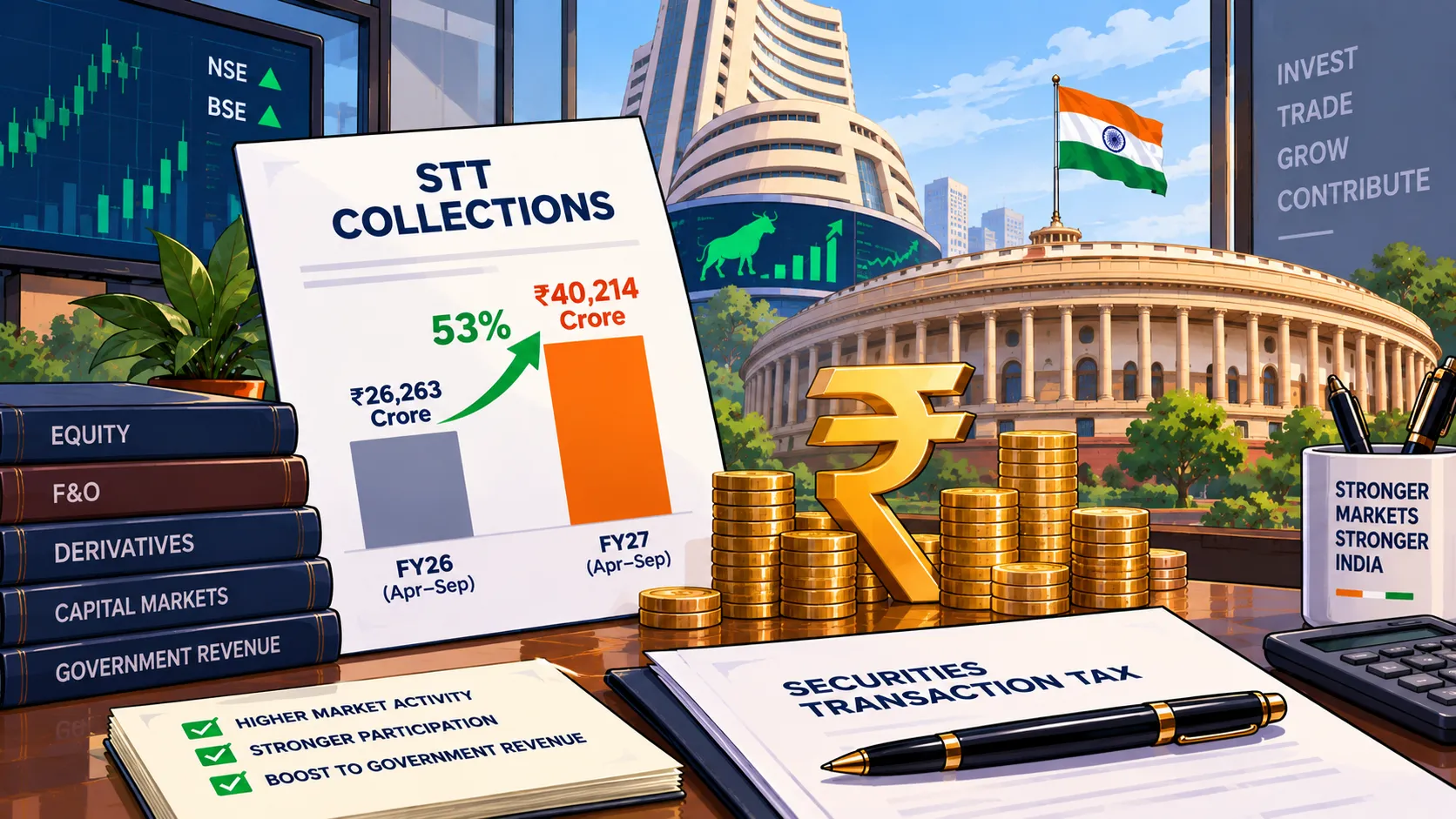
Securities transaction tax collections reached ₹40,214.36 crore between April 1 and September 17, up nearly 53 per cent from a year earlier, as higher rates on futures and options trades took effect from April 1.
The Number and the Comparison
The government collected ₹40,214.36 crore in securities transaction tax in the current financial year up to September 17, against ₹26,305.72 crore in the same period of the previous year. That is a rise of about 53 per cent, and it is already more than half of what the Union Budget projected for the full year.
For context on the run rate:
- FY27 collections to September 17: ₹40,214.36 crore
- Same period in FY26: ₹26,305.72 crore
- FY27 Budget estimate for the full year: ₹73,700 crore
- FY26 full-year collection: ₹57,522 crore
- FY25 full-year collection: ₹53,296 crore
The FY27 figure to date has also passed two-thirds of what the entire FY26 year produced, with more than six months of the financial year still to run.
What Changed on April 1
The main reason for the jump is a rate increase announced in the Union Budget and effective from April 1. The changes were concentrated in derivatives:
| Levy | Earlier rate | Rate from April 1 |
| Sale of futures | 0.02% of traded value | 0.05% of traded value |
| Options premium turnover | 0.10% | 0.15% |
| Exercised options | 0.125% of intrinsic value | 0.15% of intrinsic value |
This was the second increase in securities transaction tax since 2024. Securities transaction tax is levied on specified sell transactions in securities carried out on recognised stock exchanges, including equities, futures and options, and units of equity-oriented mutual funds. For futures the tax is calculated on the actual traded value, and for options it is generally calculated on the premium.
Why Derivatives Drive the Figure
Deven Choksey, managing director at DRChoksey FinServ, attributed the revenue increase mainly to the higher rate on derivative transactions, which means the government collects more per contract traded. He also pointed to measures taken by the Securities and Exchange Board of India, including larger contract sizes and tighter position limits, which were aimed at reducing retail speculation even as overall market transaction values have stayed high.
That combination is what makes the collection figure informative. A 53 per cent revenue rise sitting alongside regulatory tightening suggests the increase is coming largely from the rate change rather than from a proportionate jump in trading activity.

Derivatives turnover has faced pressure over the past month after further measures, including the closing auction session and a requirement for 100 per cent collateral. Those changes affect the volume base on which the tax is collected, which is a reason the second half of the year may not simply extrapolate from the first.
Where STT Sits in the Direct Tax Picture
Securities transaction tax forms part of the government's direct tax collections, and the wider direct tax numbers released by the finance ministry on Friday were also strong. Net direct tax collections rose 13 per cent year on year to ₹12.124 lakh crore between April 1 and September 17, helped by a nearly 20 per cent increase in corporate tax collections.
That total accounts for about 45 per cent of the ₹26.97 lakh crore direct tax target set in the Budget for 2026-27. The government has projected total tax collections of ₹44.04 lakh crore for FY27, up 9.4 per cent year on year, with direct taxes budgeted 18.1 per cent higher than the FY26 level.
Against those aggregates, securities transaction tax is a small line item. Its value as a signal is disproportionate, though, because collections move with trading volumes, which in turn track secondary market activity fairly closely.
Also Read: Bank Services Face a Five-Day Disruption From September 26
What Traders Should Take From It
For anyone active in futures and options, the collection figure is a reminder of a cost that is now materially higher than it was in the last financial year. On the sale of a futures contract, the levy has gone from 0.02 per cent of traded value to 0.05 per cent, which changes the arithmetic on high-frequency and short-holding strategies where transaction costs are a large share of expected return.
The fiscal reading is separate. With ₹40,214 crore collected in under six months against a ₹73,700 crore annual estimate, the Budget target looks achievable on current trends, though the recent pressure on derivatives volumes is the variable that will decide whether collections keep pace through the second half.